 |
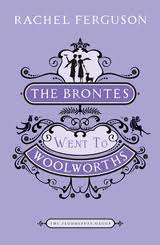
| The lovely Bloombsury edition I borrowed from the library. |
As children, the Brontes wrote about their imaginary worlds of Gondal and Angria, enacting the stories and playing the parts of the characters they created. The adult Brontes make brief, ghostly appearances in The Brontes Went to Woolworths, by Rachel Ferguson, and their spirit pervades this strange novel about a family who keep the real world at bay by creating a fantasy land, inhabited by invented people.
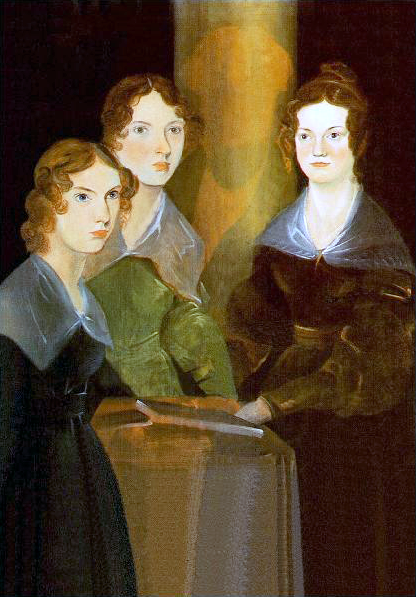 |
| Anne, Emily and Charlotte painted by their brother Branwell.He took himsel out of the picture, but the ghost image can still be seen. |
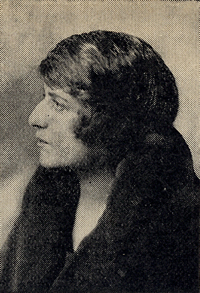 |
| Author Rachel Ferguson may have used her knowledge of the theatre – she was an actor and drama critic – when writing the book. |
Intellectually and socially snobbish, the women are waspishly sharp, very intelligent, and rather Bohemian, giving the impression they have come down in the world since the father died. Despite Deirdre’s work and Katrine’s theatrical studies, they seem cut off from outside world, hiding behind self-imposed barriers, with few friends – they don’t relate to others and are quick to make fun of people they regard as lesser mortals, like the governesses, or Deirdre’s editor. They delight in the pretence of talking to strangers as if they know them, and enjoy comic, mock Shakespearean speech among themselves, that others can’t understand.
Strangely, the girls don’t play conventional games, don’t believe in fairies or Father Christmas, and don’t like Peter Pan or dolls (with exception of plain Ironface, who ran off and married a French aristocrat, but returns to offer observations on life). Similarly, they have scrapped the usual ‘fairytale nonsense-literature’ for Sheil’s toy theatre, and instead stage their own pantomimes with ‘genuine illusions’, for ‘charities’, like the Tabbies’ Protection Union (with offices in Great Cream Street). Presumably, all this indicates that they want to concoct their own fancies, rather than relying on the dreams of others.
 |
|
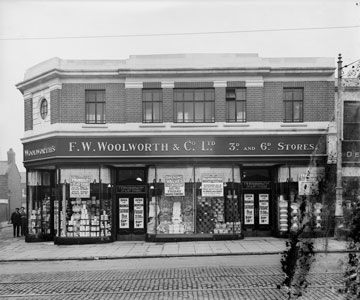
The Woolwoths store in Wavertree Road, Liverpool, pictured
in 1931. The photo, commisioned by FW Woolworthe and Co Ltd can be seen at, http://www.liverpoolmuseums.org.uk . |
But there is a darker side to all this whimsy. The obsessive nature of the family’s interest in their chosen subjects (for Toddy is not the only one) is deeply disturbing. “We learn everything there is to learn about people we love,” explains Deirdre. In this day and age it would probably land them in court on a charge of stalking, while their habit of inviting these imaginary ‘friends’ to dinner, and ensuring the ‘guests’ send presents for birthdays and Christmas would almost certainly result in some lengthy counselling sessions.
 |
|
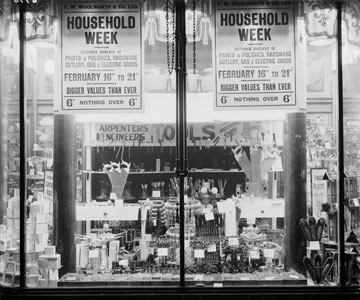
Window display in Woolworth’s store, London Road,
Liverpool, in 1931, the year The Brontes Went to
Woolworths was published.
|
And what about poor Agatha Martin, the first governess, who obviously feels threatened by the Carnes, and is desperate to shock Sheil out of her make-believe world, yet has a pretty shaky grip reality herself. She fantasises about a curate whose unsatisfactory letters are brotherly and matter-of-fact – so she’s written love letters from him to herself, and is as obsessive about him as the sisters are about Toddy and all their other creations.
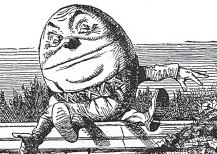 |
| A Tenniel drawing of Humpty Dumpty – does Lewis Carroll’s ‘Alice Through the Looking Glass’ offers clues about Rachel Ferguson’s novel? |
Theatrical references abound (even the court can be seen as a performance where the judge plays a role) and there’s a quote from Lewis Carroll’s looking glass world: “How right was Humpty Dumpty to abuse words and then pay them on a Saturday night! It was a really magnificent gesture, and one which slaves to split-infinitives would do well to copy.” Perhaps that choice from an author whose work abounds with puzzles about illusion and reality, and the real meaning of things, offers a clue to the way we should look at Ferguson’s novel. Perhaps life, like words, can be shaped to make what we want, and we can take control by abusing the conventional view of reality and forging a new version of the world for ourselves. Or perhaps the whole novel is a fairy tale, or a dream, and not to be taken seriously at all.

 The Book Trunk
Leave a reply to ChrisCross53 Cancel reply