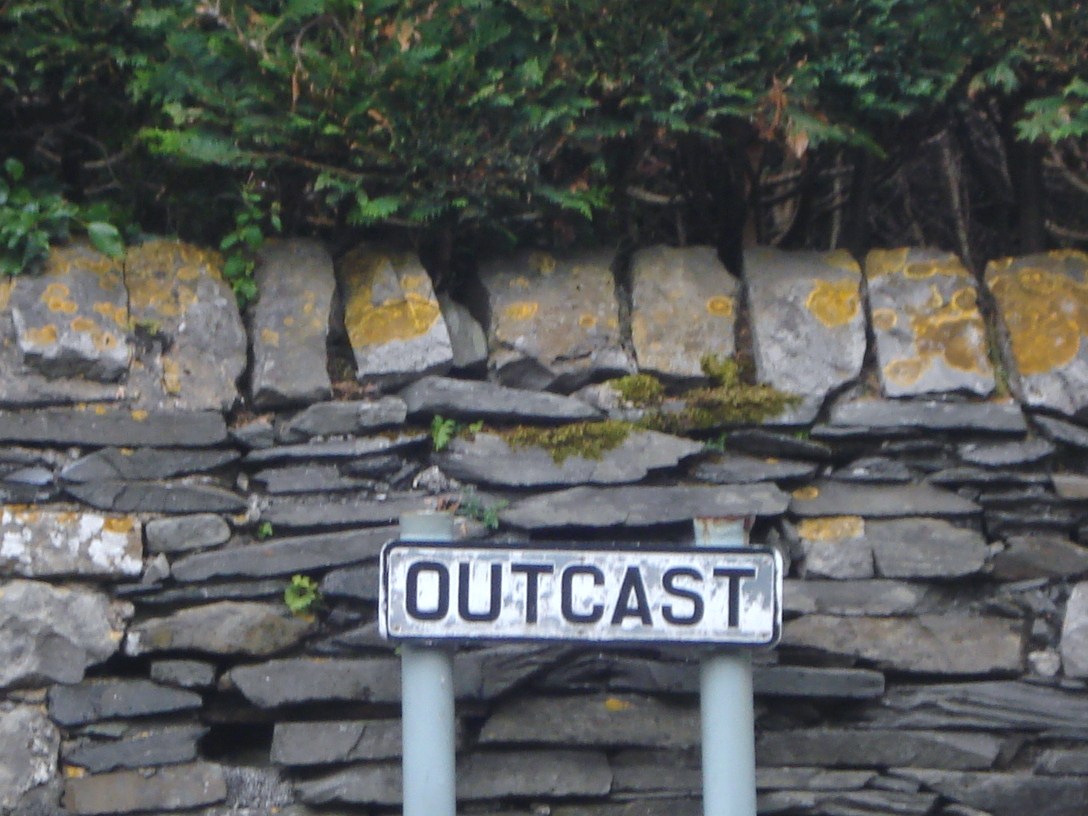
We passed this sign whilst out walking during our Cumbrian holiday. It’s the name of an area, like a hamlet, which is certainly not big enough to be a village, and is now part of Ulverston. According to a local information leaflet, it was once the place where lepers were sent – cast out from the community where they lived before. However, there are no further details, and I’m having problems trying to find anything out, so I may contact the tourist office and see if they can recommend a local historian who may be able to help.

Anyway, the sign reminded me of ‘The de Lacy Inheritance’, written by my friend Elizabeth Ashworth, which has one of the most chilling openings I have ever read, with words taken from The Mass of Separation, which excluded lepers from family, home, society and church.

I’d never heard of this particular custom, so I looked it up, and found the ritual spoken by a priest even more horrifying than Elizabeth made it sound, with a curious incantatory quality, which reads like an ancient curse. It is hard to imagine listeners remaining unmoved by the rite, which banned lepers from any form of normal human contact – even touching the rim or rope of a well was forbidden unless the sufferer was wearing gloves. It must have been such a lonely life, cut off from everyone they knew and loved, unable to make a living or indulge in any leisure pursuits, and denied even the comfort of the church (although some places of worship had a special window, so sufferers could stand outside and listen to a service).

It made me realise what a terrible disease leprosy was in the days before drugs were available to cure it (it was well into the 20th century before this happened – Victoria Hislop’s novel ‘The Island’ shows how attitudes changed). I always think of lepers living in special hospitals, or lazar houses as they were known, where they were cared for by monks, but I may have gleaned this idea from Ellis Peters’ excellent Cadfael books, and I’m not sure how true it was. I understand there were also ‘colonies’ which were not attached to religious institutions, where sufferers lived as normally as possible, totally isolated from the rest of the world. Additionally, may beggars became became beggars, travelling from town to town, ringing a bell which warned others to keep away, eating scraps left out for them, and maybe staying the occasional night at a lazar house. For more Saturday Snapshots see  Alice’s blog at http://athomewithbooks.net/


chrisharding53 Avatar

Published by

45 responses to “A Place where Lepers were Outcast…”

  1. Barbara The Healthy Nut Avatar

    Chilling to contemplate isn't it? Molokai, one of the Hawaiian Island's was a Leper Colony during the 1800's through 1969!! Fr. Damian, a RC priest from Belgium, later canonized a saint, cared for the lepers who were segregated there. I once read a book about this part of Hawaiian history but I don't recall the name of the book. Thanks for sharing this interesting bit of history.

    Like

  2. Zan Avatar

    That's very sad- I'm glad I had the moment to learn and experience a little through this, though. Thank you!

    Like

  3. Alyce Avatar

    It is so sad to think of what their lives were like back then.

    Like

  4. Christine Harding Avatar

    Thank you for sharing the information about Molokai. I will try and see if I can find the name of the book – I'd be interested to know more.

    Like

  5. Christine Harding Avatar

    Thank you for commenting – hearing about the way lepers were treated in the past makes me feel sad as well, and grateful for the advances in knowledge and medication.

    Like

  6. Christine Harding Avatar

    Alyce, it doesn't bear thinking about.

    Like

  7. Irene Avatar

    What a horrible thought, I'm quite sure some of these things still exist, perhaps not so extreme. One of our highschool teachers goes to a colony and works for the summer, not sure what he does, but I suspect he teaches. I know my mom use to send money to Leprosy Missions so this sign may not be so old. Great post, thanks so much for the awareness.

    Like

  8. Christine Harding Avatar

    Thank you Irene – I know leprosy (or Hansen's Disease as it is now known) is still a problem in some parts of the world, and it's interesting to hear of people who help by working in a leper colony or sending money to missions.

    Like

  9. Creations by Laurel-Rain Snow Avatar

    It was a horrific past for those with the disease. Thankfully, times have changed. But I'll bet some of the prejudices linger….

    Thanks for sharing…and for visiting my blog.

    Like

  10. Christine Harding Avatar

    I am sure there is still prejudice and lack of understanding. Apparently some people thought it was caused by divine punishment for wrongdoing, while others regarded lepers as living dead, and decided they were serving their time in purgatory!

    Like

  11. Trish Avatar

    How horrifying. I'm glad we live more humane and educated times.

    Like

  12. Eugenia O'Neal Avatar

    For some reason, perhaps because of their outcast nature lepers and how society treated them, I've always found this a fascinating topic. Up to about 1930 or so, our lepers lived behind our present hospital and were not allowed to walk the streets but, if they had to for whatever reason, they had to ring a bell so people would know to stay away. Unfortunately, the little houses where they stayed were torn down a few decades ago.

    In How to Escape From a Leper Colony by Tiphanie Yanique, based on the real-life leper island off of the island of Trinidad, the lepers were tended by Catholic nuns.

    Like

  13. Christine Harding Avatar

    That was what I thought, but on reflection we can be just as ignorant about things today – what about reactions to HIV/Aids?

    Like

  14. Rita Avatar

    When someone leaves a comment on my blog I usually click on their name and go to their profile. From there I visit all the blogs they have listed. Your profile is not activated and I would not have found you until I took a second look at your comment and finally noticed the link to this site.

    You can activate your profile and still have your privacy without giving any information about yourself. It would make bookmarking your blog and visiting you much easier. I also think it would increase your readership because others may do what I did and just go on without taking the time for that second look at the comment.

    Please forgive my getting on my soapbox with the above. Just wanted to make sure you knew it was hurting your number of visitors.

    I also found your post very interesting. I have read a great deal about the leper colonies and know how hard life was for those who lived and worked in them. Being shunned and outcast on top of having this terrible illness did not make for a happy life. And, can you imagine the fear of those that choose to care for the lepers. The knowledge that they could find themselves in the same situation at any time must have been horrible.

    Like

  15. Christine Harding Avatar

    Eugenia, thank you – that's another recommendation for a book that I shall try and follow up. I didn't realise they were still ringing bells in the 1930s to make people avoid them – I wonder widespread that was at that time?

    Like

  16. Christine Harding Avatar

    Rita, I thought the profile was activated, but I'm not very good with computers, so I'll check it out and try to alter it – I'm grateful to you for mentioning it. I'm glad you found the post interesting.

    Like

  17. Melissa @ Melissa's Bookshelf Avatar

    Interesting photo… Very sad to think what it must have been like for those suffering from leprosy.

    Like

  18. edgar Avatar

    It gives us time to pause and say a prayer for the outcast and forgotten. We should not be afraid of the people with leprosy.
    Thank you for the article.

    Like

  19. Arti Avatar

    That single word sounds chilling and callous… But then again, not unlike the isolation we still practice in our hospitals. I just can't imagine living in a few centuries back, with no modern medicine and convenience. It's horrifying to think of those leprosy sufferers and their families.

    Like

  20. Dragonfly Daydreams Avatar

    There was a wonderful book written by Alan Brennert called Moloka'i. It was a fictionalised account of the leper colony in Hawaii – fascinating and horrifying in parts.

    Like

  21. Paulita Avatar

    That is fascinating and sad. I think of the people who we are isolating now in different ways for their differences. I think we'll live to regret that too. Here's Mine

    Like

  22. Wrighty Avatar

    That is so interesting but heartbreaking. It's sad how we treat people and situations we don't understand. Thank you for the information you provided in your post.

    Like

  23. Bev Hankins Avatar

    It is sad how people were treated then. I think of the Bible stories where the lepers were required to call out “Unclean, unclean!” as they approached. And it's good to know how far we've come in treating this disease.

    Here's my Snapshot.

    Like

  24. Christine Harding Avatar

    Quite apart from the disease itself, the isolation and lack of contact with those they knew must have been terrible.

    Like

  25. Christine Harding Avatar

    Edgar, I agree with you – and we should look at the way these people were treated in the past, and ensure we do not treat anyone that way today, whatever disease they may be suffering from.

    Like

  26. Christine Harding Avatar

    That must be the one Eugenia mentioned, but she couldn't remember the author, so thank you for the information – it will make it easier to track the book down.

    Like

  27. Christine Harding Avatar

    I think our reaction to leprosy has been conditioned by all those centuries when there was no cure or effective treatment.

    Like

  28. Christine Harding Avatar

    Thank you for commenting Paulita, and you are absolutely right – there are still people who are being isolated.

    Like

  29. Christine Harding Avatar

    It is fear of the unknown that makes people so cruel I think. The disease could make sufferers look very scary, and people were scared of catching it. Apparently many of those who cared for lepers in the special hospitals did eventually contract the disease.

    Like

  30. Christine Harding Avatar

    I thought of the Bible stories as well, and it is good that leprosy is treatable, but there are other medical conditions where people still get the support they need and are rejected by society, although not in such a formal fashion.

    Like

  31. (Diane) Bibliophile By the Sea Avatar

    I enjoyed reading your post, but so sad how these people were treated.

    Like

  32. Stacy at The Novel Life Avatar

    Thank you for sharing such a moving picture and reminding us how far we have come from segregation – of any sect of peoples. It's so hard to contemplate how cruel society has been to lepers and more recently, anyone with HIV/AIDS. Very interesting post!

    Like

  33. Sheila (Bookjourney) Avatar

    Wow. Now I want to read your friends book. How sad….

    Like

  34. Christine Harding Avatar

    I'm glad you enjoyed it Diane, but it certainly made me think about prejudice, and wonder how much further forward we realluy are.

    Like

  35. Lmkazmierczak Avatar

    Thanks for the historical info♪

    Like

  36. Christine Harding Avatar

    Stacy, you felt the same way that I did. I suppose there will always be human beings who will find some group of other people people they believe should be segregated, such as Aids/HIV, mental illness, Jews, ethnic minorities… sadly the list just goes on and on.

    Like

  37. Christine Harding Avatar

    It is published by Myrmidon Books and is available through Amazon I think. She writes a lot about Lancashire, where she lives, and her website is at http://elizabethashworth.com/

    Like

  38. Christine Harding Avatar

    Thank you for visiting my blog!

    Like

  39. Leslie (Under My Apple Tree) Avatar

    Very sad. What people don't understand, they fear.

    Like

  40. Christine Harding Avatar

    That is very true Leslie.

    Like

  41. Nan Avatar

    I just saw a documentary called Triumph at Carville. I think I read you have Netflix over there now? If so, it is available from them. Very interesting. Here's more info:

    http://www.pbs.org/programs/triumph-at-carville/

    Like

  42. Meaghan Avatar

    I have seen documentaries on leprosy before and always wonder about how lonely that life would have been. I cannot imagine being cut off from everyone like that. You picture is definitely a reminder of how hard it is to be an outsider. Very moving.

    Like

  43. Christine Harding Avatar

    Thank you Nan – I will try the link shortly, but computer is playing up like mad, and it may not work.

    Like

  44. Christine Harding Avatar

    Meaghan, thank you for your kind comment. I think the sign made an impact on me because it is such a tangible link with the past.

    Like

  45. Kate Gomez Avatar
    Kate Gomez

    Think placenames are so important, sometimes the only link to an otherwise forgotten past. By the way, I think there was a lepers hospital between Lichfield & Tamworth on the site of Freeford House. Lots of skeletons were found there when the road was widened. Some of the masonry in the new building is said to come from the chapel but other than this I'm not sure if there is any indication of the site's history. If not it's a shame.

    Like

Leave a reply to (Diane) Bibliophile By the Sea Cancel reply