Kilmeny had been, she knew not where,
And Kilmeny had seen what she could not declare;
Kilmeny had been where the cock never crew,
Where the rain never fell, and the wind never blew.
That’s the only bit I can ever remember from James Hogg’s spooky poem ‘Kilmeny’, but I’ve always loved its haunting quality. So when I learned that LM Montgomery, author of the wonderful Anne of Green Gables, had written a book titled Kilmeny of the Orchard, I was interested, and thought it would be an ideal choice for the Canadian Book Challenge. This was earmarked for my September contribution, but although I read it last month I’m behind with posts, as I explained earlier in the week, and there will be two Canadian reads during October so I can catch up.
Anyway, I digress. Nan, at Letters From a Hill Farm, really rated this, but I’m not so enthusiastic. Bits of it were delightful, and Montgomery is excellent on descriptions of scenery and wildlife, but overall it really, really irritated me. Our heroine, the beautiful and virtuous Kilmeny is just too perfect, and lacks the appeal of Anne Shirley. I always find Anne very endearing and human, but Kilmeny is neither. The novel also lacks the humour of Anne of Green Gables – not that every novel needs to be funny, but the occasional laugh would have levened the mix in this one.
But what annoyed me most was the notion that that beautiful people are good and clever, and that foreigners are somehow not quite right, and a are ‘low’ and not to be trusted. I know theories like this were widespread when the novel was published in 1910, but I thought they were distasteful in the extreme, and there are other novelists writing at the same time who didn’t express such views.
And I found the hero’s obsession with naive, childlike Kilmeny, and his assertion that he will teach her everything she needs to know was more than a little disturbing.
Possibly, at this point I should try and give you a brief synopsis of the book, otherwise my comments will make no sense whatsoever. So, here goes. Eric Marshall has just graduated from college, but has no need to work because he is heir to a fortune and will work in his father’s department store. However, he agrees to help a sick friend by temporarily taking over as schoolmaster to a small community on Prince Edward’s Island. In the beautiful woods he catches a glimpse of a beautiful young maiden playing beautiful music on her violin. She is Kilmeny, who is an orphan and is very beautiful – oh, sorry, I have already mentioned that, but Eric can only ever love a beautiful woman (shallow bastard). Anyway, she cannot speak, but communicates most ably (and beautifully) by writing lengthy messages incredibly quickly. Brought up by her dour uncle and aunt, who are brother and sister, Kilmeny has never been to school, and never mixes with people.
She’s a mysterious figure with a tragic back story dating back to the months before her birth – for her father discovers his first wife is not dead, as he thought, but very much alive, and Kilmeny’s goes mad. Well, maybe I exaggerate. She has some kind of breakdown and becomes very peculiar indeed.
Eric, who is terribly good looking, and clever, and everything that is right and honorable, has clandestine meetings with with Kilmeny because he loves her and she loves him. But there is a fly in the ointment…
Before our upright hero can tell Kilmeny’s guardians he has been meeting their niece in secret, and ask for her hand in marriage, Neil, the son of Italian pedlars who has been brought up by the aunt and uncle (his mother died and his father ran away) tells on them because he is love with Kilmeny (are you still with me?). I felt sorry for Neil, who is portrayed as ‘sullen’ and ‘low’, a thoroughly bad lot, because of his Italian heritage!
Kilmeny won’t marry Eric because she can’t speak, and Eric’s friend, a brilliant doctor, believes her muteness is caused by some kind of psychological disorder, and she may speak if she is shocked into it.
All ends happily, of course, so there you have it it, a sweet, charming, romantic fairy tale – only I don’t think it is really. None of the characters really came to life, and Kilmeny and Eric are so beautiful and perfect and good that it’s positively sickening.
And, as I said before, it’s idealogically unsound, even if some of ideas were prevalent at the time, and there is stuff about children paying for the sins of their parents which also annoyed me, and it’s chock full of that rather cloying sentimentality which was so popular with Victorian and Edwardian readers (but not with me).
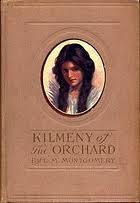
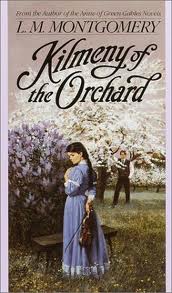
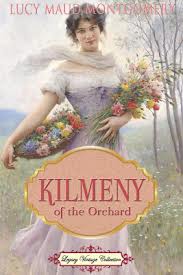
By the way, downloaded this from Project Gutenberg, and read it on the Kindle, which is not an attractive image, so I’ve used pictures of book coves to brighten things up a little! And I should mention that Montgomery quotes quite extensively from the poem, and if you want to read it you’ll find it here.



Leave a Reply