 |
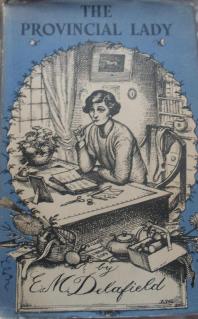
My copy of Macmillan’s 1947 four-in-one
The Provincial Lady doesn’t have a dust
jacket, bit would originally have had one
like this. |
One of the great joys of volunteering in a charity bookshop is that occasionally – well, fairly frequently if I am to be totally honest – I come across a book I really, really want. In this particular instance the Object of Desire was a volume containing FOUR Provincial Ladies, so how could I resist? (Query: Was it sound financial management to buy this, when I already have the First Diary, even if it is covered in inappropriate Cath Kidston chintz, and The Second, downloaded from Project Gutenberg Australia?)
Actually, I think it was money well spent, because the first PL book is the only one readily available. In addition, I have a wonderful book to lift my spirits, and Oxfam has £4.99, of which 84 per cent will go directly into the pot for emergency response, development work and campaigning for change, while the remainder covers support and running costs, and fundraising costs. Sorry about the plug, but I think it’s a point worth making, because there’s a general perception that most of the cash donated for charities goes on administration, and while I don’t know anything about other organisations, as far as Oxfam is concerned this is simply not true.
Anyway, my ‘new’ 1947 edition of EM Delafield’s The Provincial Lady is a faded blue (easy on the eye, but not very photographic) and currently has pride of place on the bookshelf. Published by Macmillan & Co, it contains Diary of a Provincial Lady, The Provincial Lady Goes Further, The Provincial Lady in America, and The Provincial Lady in Wartime, with a foreword by Irish writer Kate O’Brien.
I’ve already written about Diary of a Provincial Lady, so rather than individual posts on each of the other books, here are a few thoughts on the follow-ups.
The Provincial Lady Goes Further is, if anything, even funnier than its predecessor. Our heroine has become a successful author, and is disturbed by the curious behaviour of neighbours who now suspect her of Putting Them into a Book. Despite her new-found literary fame her financial situation is as precarious as ever, but she engages a holiday tutor for the children, takes the family on holiday to France. and acquires a flat in London with the intention of writing uninterrupted by the trials and tribulations of domestic life. However, she’s easily distracted and, as usual, nothing in her chaotic life goes according to plan. She remains surprisingly good-humoured as she totters from crisis to crisis, but makes acerbic comments about her friends, family, acquaintances, and people’s social pretensions.
It’s the throw-away lines I love – non sequiturs on domestic life that get a mention, but are never referred to again. For example:
Cook sends in a message to say that there has been a misfortune with the chops, and shall she make do with a tin of sardines?
What kind of misfortune can occur to chops? Did Helen Wills (the cat) eat them? Did they get dropped? Did Cook burn them? Had they gone off? And what kind of substitute meal could one rustle up at short notice with sardines, which I assume must have been tinned? Alas, we never learn: it’s just one of those unaccountable domestic disasters which occur in the best regulated households. It reminded me of the time in my own (unregulated) household when I was in the office on weekend duty, so the Man of House set about cooking fish fingers, mash and beans for The Daughters, only to discover there were no fish fingers. So, with great ingenuity, he tipped beans into a dish, piled mashed potatoes on the top, and told the girls it was Fish Finger Surprise – the surprise being that there were no fish fingers. But they ate every mouthful without complaint as they searched for the missing ingredient, something they rarely did for me!
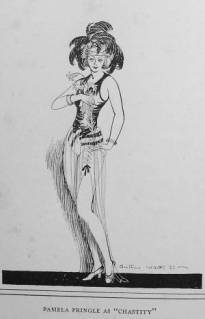 |
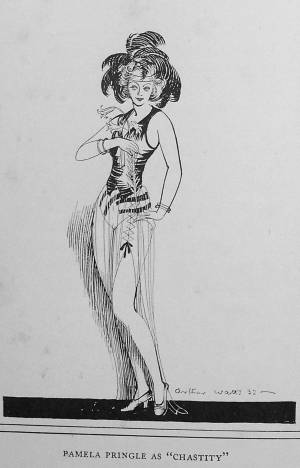
Pamela Pringle, in an illustration by
Arthur Watts for The Provincial Lady
Goes Further. |
Old friends, like Our Vicar’s Wife, are still present, but the book is enlivened by the arrival of Pamela Pringle (known to the Provincial Lady many years ago as Pamela Warburton), who is extraordinarily beautiful and rich, has run through a collection of husbands and lovers, but claims never to Lead a Man on, and maintains it is not her fault that men have always gone mad about her.
InThe Provincial Lady in America our unnamed heroine’s American publishers invite her on a publicity tour, so she sub-lets her London flat and buys new clothes – most of which turn out to be as unsuitable as her existing wardrobe, and which look distinctly crumpled when she unpacks them. She is ill crossing the Atlantic aboard a luxury liner and, as usual, I find myself sympathising with the agonies of a fellow bad traveller:
New remedy for sea-sickness provided by Rose may or may not be responsible for my being still alive, but that is definitely the utmost that can be said for it.
Once in America she is whisked off on a relentless merry-go-round of lectures, social events, and yet more travel. She follows a rigid timetable, and finds there is little time to do the things she wants. She does manage to stand her ground about visiting home of Louisa May Alcott (her own literary heroine), but only through the intervention of an eminent critic. She discovers cocktails, which give her Dutch courage, and finds that Tea Parties are a Feature of Life.
Am by this time becoming accustomed to American version of a tea-party, and encounter cocktails and sandwiches with equanimity, but am much struck by scale on which the entertainment is conducted…
As inept and amenable as ever, she is terrified by American women, and I can’t say I blame ber. The ones she meets would scare a saint: they are over-bearing, voluble, energetic, enthusiastic, well dressed, organised, well read, knowledgeable, determined, and will brook no opposition to what they want. The Provincial Lady soon realises that will never take ‘no’ for answer, that they have their own ideas about what a British author likes and dislikes – and that nothing she does or says will change their minds. But on the whole they are kindly, and very hospitable and, as in the first two books, it’s the small incidents which delight, and the descriptions of people and places.
However, there’s a change of tone in The Provincial Lady in Wartime, which feels a little more forced and is not as funny as the other books. Apparently, she had decided there would be no more PL books, but her publishers asked her to resurrect the character at the start of WW2, so perhaps that’s why it seems to lack sparkle. There’s also a poignancy about the book, especially when the Provincial Lady mentions her son Robin (still at school, but almost old enough to be called up) for Delafield’s own son, Lionel, was killed in an unexplained accident at an Infantry Training Centre in 1940, the year the book was published.
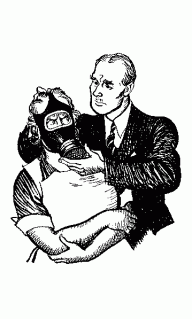 |
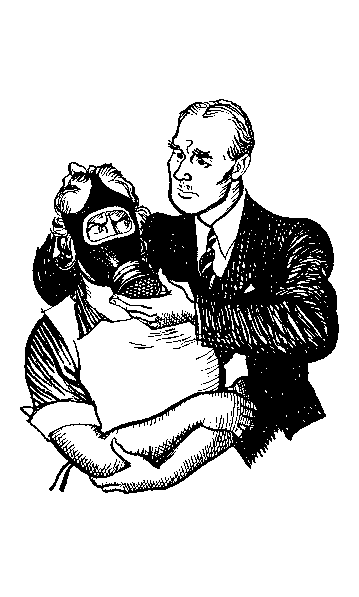
Robert trying a gas mask on Cook, from an illustration
by Illingworth for The Provincial Lady in America. |
It covers the first few months of the conflict, the ‘phony war’ when little was happening, and many people were convinced that things would somehow be resolved peacefully. Evacuees descend on the village – an event which neither evacuees nor villagers are prepared for – while Robert, our heroine’s husband, dispenses gas masks to everyone in his role as ARP organiser for the district.
Cook shows a slight inclination towards coyness when Robert adjusts one on her head with stout crosspiece, and replies from within, when questioned, that It’ll do nicely, sir, thank you. (Voice sounds very hollow and sepulchral.)
Robert still dissatisfied and tells me that Cook’s nose is in quite the wrong place, and he always thought it would be, and that what she needs is a large size.
The Provincial Lady moves to London, hoping to put her literary skills to good use with the Ministry of Information. But, like everyone else, she finds herself ‘Standing By’ and volunteers in the WVS canteen at an underground ARP station. A whole host of new people are introduced, but I felt there was an element of cruelty in some of her descriptions, turning them into caricatures rather than characters. The Commandant is a grotesque re-incarnation of Charmian Vivian, Director of The Midland Supply Depot in The War Workers, and the portrayal of Granny Bo Peep tips over the edge of comedy into unkindness. There’s a darker edge here, a tenseness, with people deprived of concrete information trying to sift rumour from from reality as they wait to see what will happen.
But Delafield is still witty, still able to poke fun at social pretensions, and still recognises that it’s the small every-day things that people worry about, rather than major issues, and can still be very funny.
I have yet to find a copy of ‘The Provincial Lady in Russia’ (also published as ‘Straw Without Bricks: I visit the Soviets’) which Delafield wrote after visiting the USSR.
PS: If there’s anyone out there who wants a hardback Virago Anniversary edition of The Diary of a Provincial Lady, I have one going spare, and I don’t want anything for it (unless postage is exorbitant!). It’s in really good condition, apart from a small patch of missing surface on one page of Jilly Cooper’s introduction – it looks as if something sticky got pulled off the paper.


Leave a Reply