Well Wishing where a Saint Stood…

St Chad’s Well, at St Chad’s Church, Lichfield. I’m sure it is
much nicer in summer, when the vine growing over the roof
is green, but at the moment it looks like a haystack on legs.
Today is the Feast of St Chad, so for my Saturday Snapshot I have some photos of his well, and a couple of old photos to show what it used to like in the past. Before moving to this area I’d never heard of Chad, but it’s difficult to live here and not stumble across him somewhere, for he was Bishop of the ancient Saxon kingdom of Mercia. Tamworth, where I live, was the capital of this realm, and St Chad established his Episcopal seat at Lichfield, where I once worked on the local paper, and now volunteer in the Oxfam book shop.  

 I think about him sometimes when I’m on one of my daily walks because, according to Bede in ‘A History of the English Church and People’, he went about on foot rather than on horseback,  and was  reluctant to change this ‘pious exercise’, which he loved. His archbishop considered it more fitting that Chad should ride, and on one occasion insisted on helping him on to a horse, but I like to imagine the saint flouting the order when his superior was out of the way, and continuing to stride about the countryside. 
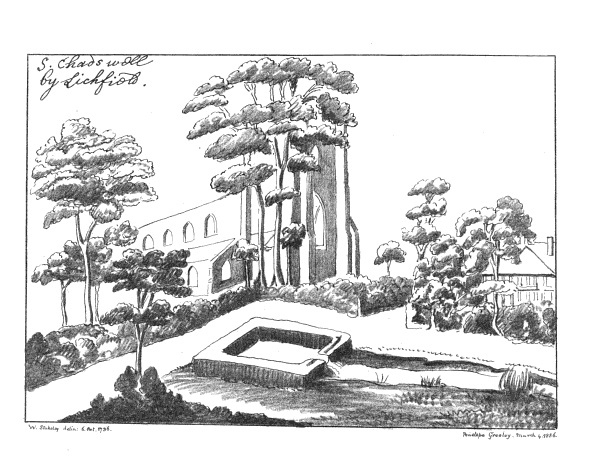
St Chad’s Well, drawn by William Stukeley in 1736. 
He became Bishop of Mercia in 669 and immediately made Lichfield the centre of his see (rather than Repton, in Derbyshire). He built a house near the church and close by a spring fed a pool where, according to 16th century antiquarian John Leland, ‘St Chad was wont naked to stand in the water and pray’.

There is still a well in the churchyard at St Chad’s, presumably fed by the spring, but its location and form seem to have changed over the years. In 1833, local physician James Rawson described it as having ‘degenerated into a most undignified puddle, more than 6 feet deep’ and said it was choked with ‘mud and filth’. Thanks to him, the water supply was improved, and a protective octagonal building erected, which must have been far more attractive than the lacklustre garden feature erected at the end of 1940s, when the well seems to have been moved. There’s a small square of water set into drab paving slabs, covered by an unimaginative tiled roof, which perches on top of four wooden supports.
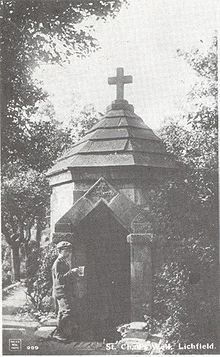
The 19th century building which covered
the well.
 St Chad died on March 2, 672 . Bede, writing some 60 years later, tells us that the burial place was covered in a wooden tomb in form of little house, with a small opening, so people could put a hand through to take some of the dust. “They mix this in water and give it to sick men or beasts to drink, by which means their ailment is quickly relieved and they are restored to the longed for joys of health,” he adds – but doesn’t say whether they used water from the well to create this macabre medicine.
Bede also describes how a wandering ‘madman’ spent a night in the church where the body was housed, and was miraculously found to be ‘in his right mind’ the following morning!
The well: people thrown coins into the water, and make a wish,
but my wish would be for it to look more like a well!
 During the Medieval period, pilgrims flocked to Lichfield Cathedral to see Chad’s shrine, but his relics were moved during the Reformation, although you can still see the Chapel of St Chad’s Head, where the Saint’s head was once displayed to the faithful, which strikes me as being a particularly grisly custom. Bones now housed at St Chad’s Cathedral in Birmingham – the Gothic extravaganza created by Pugin – are said to be those of the saint.
Saturday Snapshot is hosted by Alyce at http://athomewithbooks.net/ where you can see photos from other participants all over the world.
A statue of St Chad stands in a niche
above the door to St Chad’s Church.
 Sources: http://lichfieldlore.co.uk/2012/03/18/well-being/(an excellent site on Lichfield’s rich heritage); http://www.stchads.org.uk/ (St Chad’s Church has a website and a fascinating guidebook); http://archaeologydataservice.ac.uk/catalogue/adsdata/arch-841-1/dissemination/pdf/oxfordar1-50626_1.pdf  (report of archeological dig at the well site)

52 responses to “Well Wishing where a Saint Stood…”

  1. What a great story! Thanks for sharing the details about the well, and the photos.

    Thanks for visiting my blog.

    Like

  2. Glad you liked it. There were plans fo some kind of visitor here, but nothing came of the idea, which is a shame.

    Like

  3. I love the photos and the history surrounding the well!

    Like

  4. What a wonderful tour and history lesson. Thank you!

    Like

  5. I've always rather liked St Chad, and this was one of those places I had never really looked at, let alone thought about the history.

    Like

  6. There is an information plaque there, but it's not what you'd expect for a Saintly Well!

    Like

  7. How neat to have all that history near you!

    Like

  8. It does look rather like a cut off haystack! What a pity the 19th century shrine is no longer there. I hadn't heard of St Chad – he sounds a character, standing in the water naked to pray!

    Like

  9. What a great history lesson! So interesting!

    Like

  10. I would have never guessed that was a well. It looks like a little reflecting pond.

    Like

  11. I've been in St. Chad's Cathedral in Brimingham but was not aware of his story, thanks for sharing!!

    Like

  12. Neat photos…thanks.

    Elizabeth
    Silver's Reviews
    My Saturday Snapshot

    Like

  13. I know!I keep saying how lucky I am. I'm combining my daily walk (which is sill going strong) with my love of history.

    Like

  14. At one stage he must have been really well known, because his shrine at Lichfield was one of the most popular spots for pilgrims right up until the reformation.

    Like

  15. St Chad's Cathedral is amazing – a riot of colour and pattern, quite unlike any other religious place I've ever been in. I have some photos I took there, so I might use them in a future Snapshot.

    Like

  16. I think you could be forgiven for not realising, because it doesn't look like a well. If you moved into a house with a garden pond like that, I'm sure you'd want to redesign it!

    Like

  17. Thank you Sarah. I had so much information about him, and the various places he's associated with, that it was difficult deciding what to write.

    Like

  18. It's a very odd well, but I do rather like Chad.

    Like

  19. Glad you liked them Elizabeth. Thanks for popping by.

    Like

  20. Very interesting! I knew nothing of St Chad, so was quite intrigued by all these pictures. I agree that the 19th C. shrine is much prettier than the current one.

    Like

  21. Loved the story about the picture so interesting!

    Like

  22. What an interesting story to caption the pictures!

    Like

  23. I think he was regarded as a major figure in the early Christian Church, and in Medieval times, but now he seems to be unknown outside his own area.

    Like

  24. I'm glad you enjoyed it Sheila. He rather intrigues me.

    Like

  25. Thank you Melissa. I like history and the way things we see every day can connect us to the past.

    Like

  26. Fascinating! Thanks for sharing the photos and the stories.

    Like

  27. I hadn't heard of him before. Nice to see some real life images to go with the story!

    Like

  28. Most interesting♫ Thanks for sharing, and have a great week-end♥

    Like

  29. You live in a place not only beautiful but also rich in history. I'm grateful for your narrative and photos and giving us the story of St. Chad.

    I would love to see the “haystack” in green.

    Like

  30. Alyce, like lots of other saints I think he was abandoned and forgotten after Henry VIII dismantled so many of England's monasteries, churches etc. Before that pilgrims travelled to his shrine from all over England – apparently, pilgrims brought a lot of trade to Lichfield.

    Like

  31. I'll go back in the summer, so I can do 'then and now' photos.

    Like

  32. It's hard to imagine how seriously people took their religion in times gone by, but I like the fact that there are still links to Chad in this area.

    Like

  33. I'm pleased you found it interesting. You have a great weekend as well.

    Like

  34. Very interesting. Thanks for sharing, I love to learn new things.

    Like

  35. A lovely well and a charming story to go with it. Here's Mine

    Like

  36. “a haystack on legs” – I like it. Cool photo too.
    Thanks for this informative post.

    Like

  37. Thank you. I may have a St Chad tour, and see other places he's connected with!

    Like

  38. Yay! Someone liked the well as it is! I'm glad you enjoyed the post Paulita.

    Like

  39. I'm sure it must get pruned back at some point, and by the time it starts sprouting leaves and greening over it will look completely different – but it doesn't have much to recommend it at the moment!

    Like

  40. What wonderful history, and local too.

    Like

  41. I so love to visit your snapshot posts, as I always learn something new and interesting! I love all things English so your little history lessons and photo commentary is just such fun for me! Thanks!

    Like

  42. Susan, that is a lovely comment, which means a lot to me. Thank you.

    Like

  43. I enjoy exploring the local area and discovering its history.

    Like

  44. So fascinating! The photo is unusual (it does look like a haystack!) and the story is so interesting. Thanks for sharing. 🙂

    Like

  45. How interesting! I love the “haystack on legs” description. :-0 Thanks for sharing.

    Like

  46. Never heard of this saint. Chad is such a modern-sounding name.

    Like

  47. I will return in the summer for a better photo when it will green!

    Like

Leave a reply to Creations by Laurel-Rain Snow Cancel reply