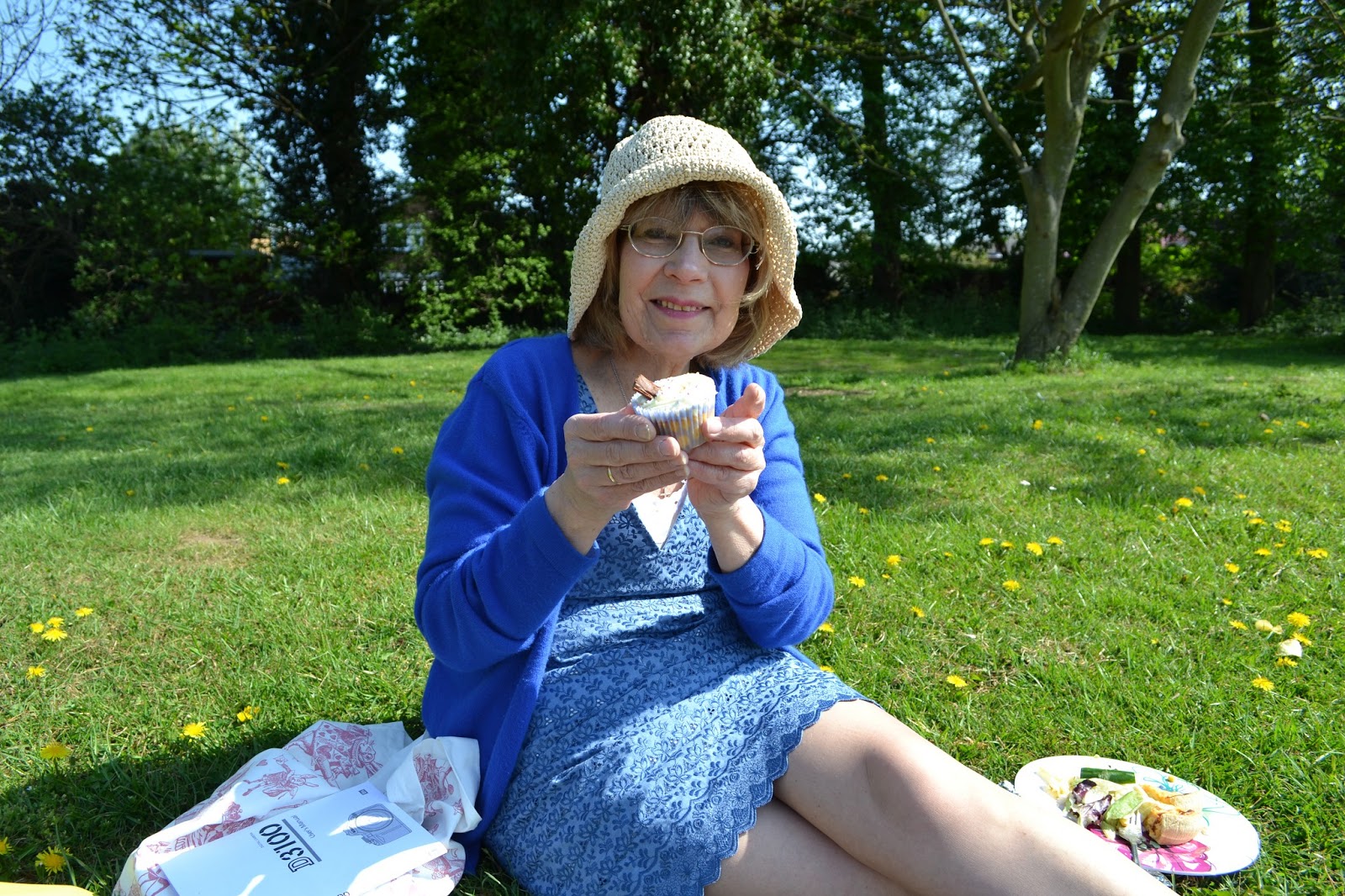
The weather has turned vile again – cold, wet, grey and gloomy. But early last week the sky was blue, the sun shone, birds sang, flowers bloomed and it was hot, hot, hot. Aa, I thought, we’ve skipped spring and gone straight to summer! It was so nice that Elder Daughter (who travelled up from Plymouth for my birthday and stayed several days) joined me on a walk around the Tree Trail at a local park and we sat on the grass and enjoyed a picnic in the sunshine, and she wore her sunglasses, and I wore my floppy sunhat. So here are some pictures I took for my Saturday Snapshot.
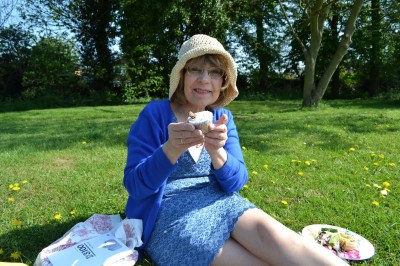 |
| Picnic in the Park… In the sunshine… Whatever that may be! |
Wigginton Park is one of the many places I haven’t been to for years and years and years, so our morning’s outing was part of my ‘Exploring the Local Area and Doing Something Different’ plan. Like most of Tamworth’s ‘wild’ spaces it’s a fairly small area, and is bounded by houses, roads and a railway line, but it’s got a fascinating history, and is a fabulous green oasis in an urban area, boasting rare trees and a wealth of wildlife. We saw grey squirrels, as wells as all kinds of birds, insects and butterflies, and came away feeling as if we’d had a trip to the country.
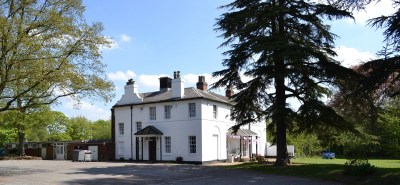 |
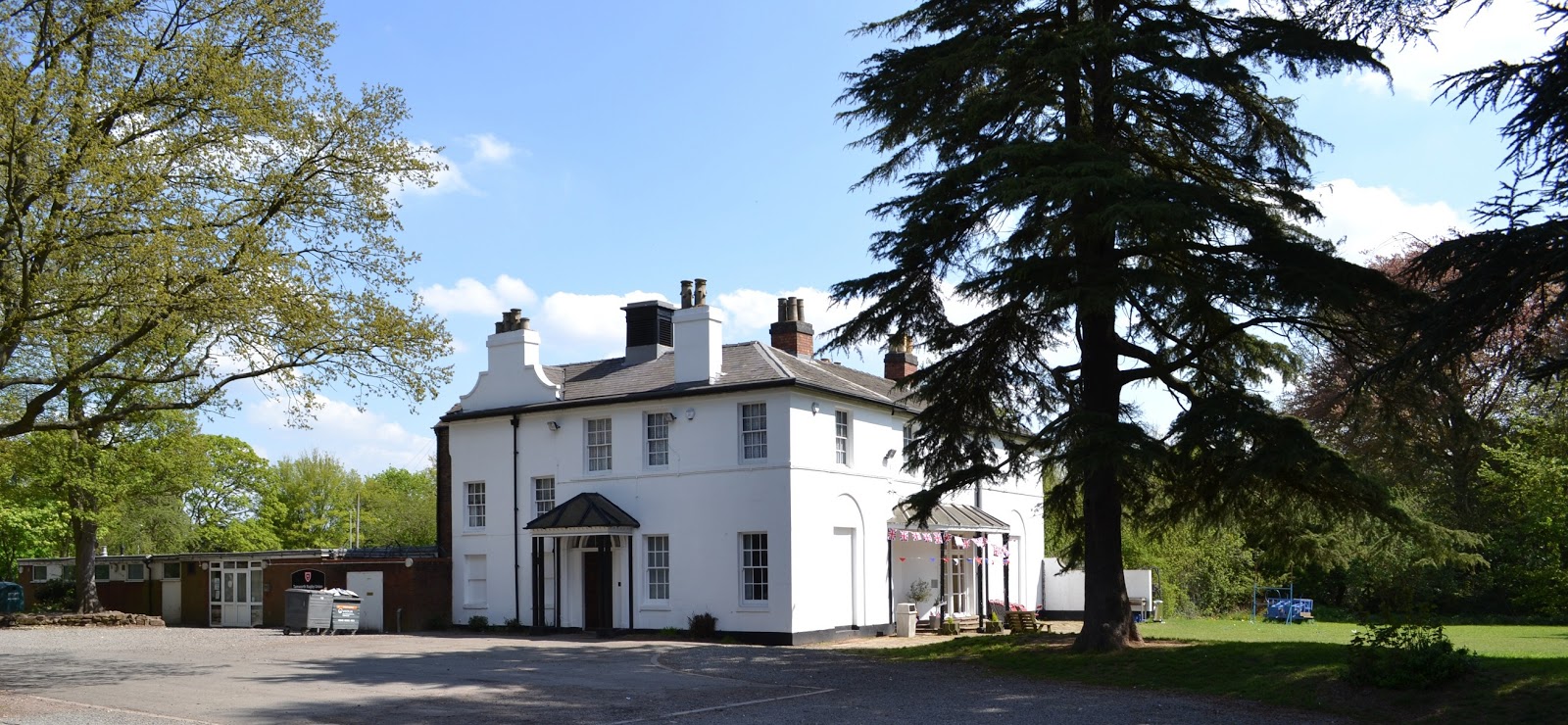
Wigginton Lodge, Tamworth: Built by fashionable women’s surgeon John
Clarke and his wife Elizabeth in the early days if the !9th Century. |
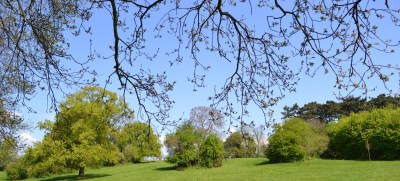 |
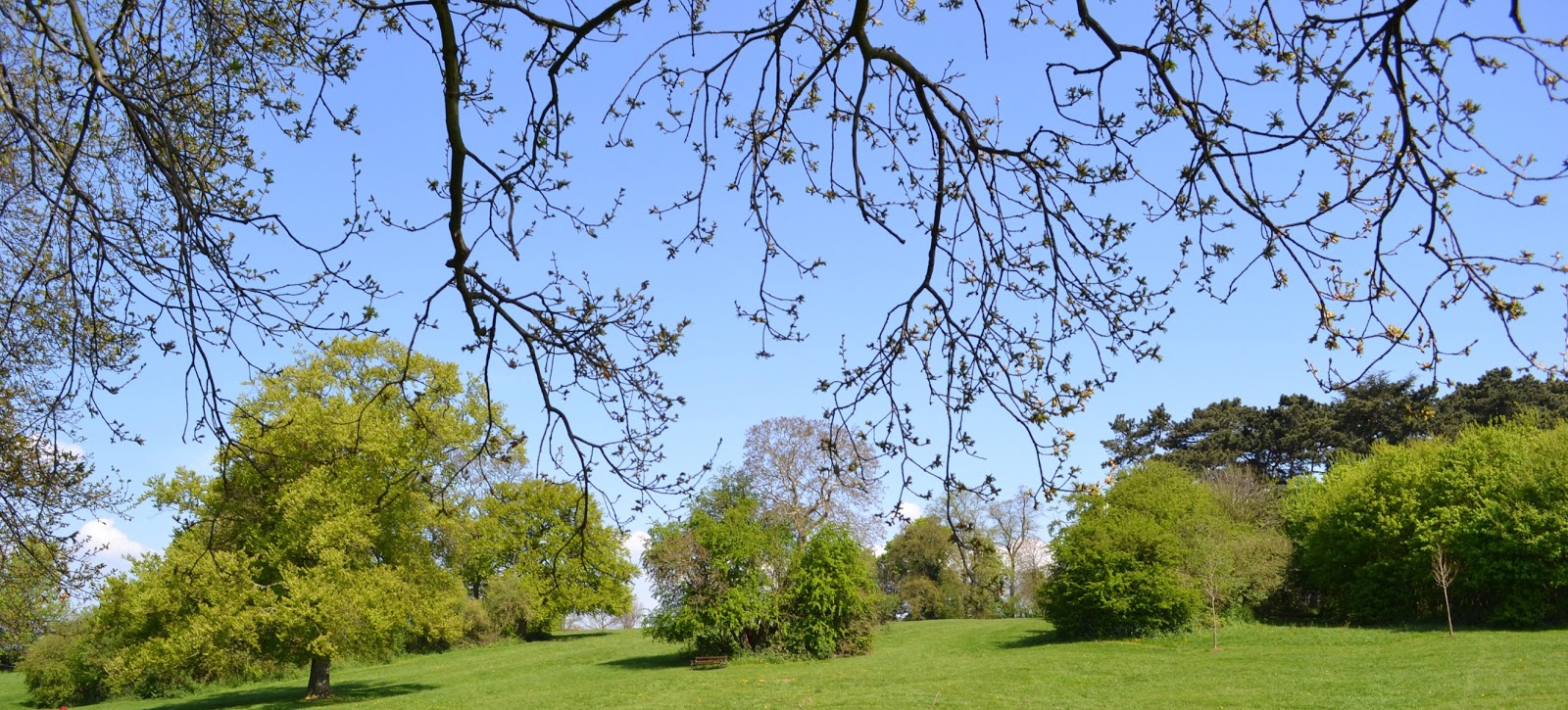
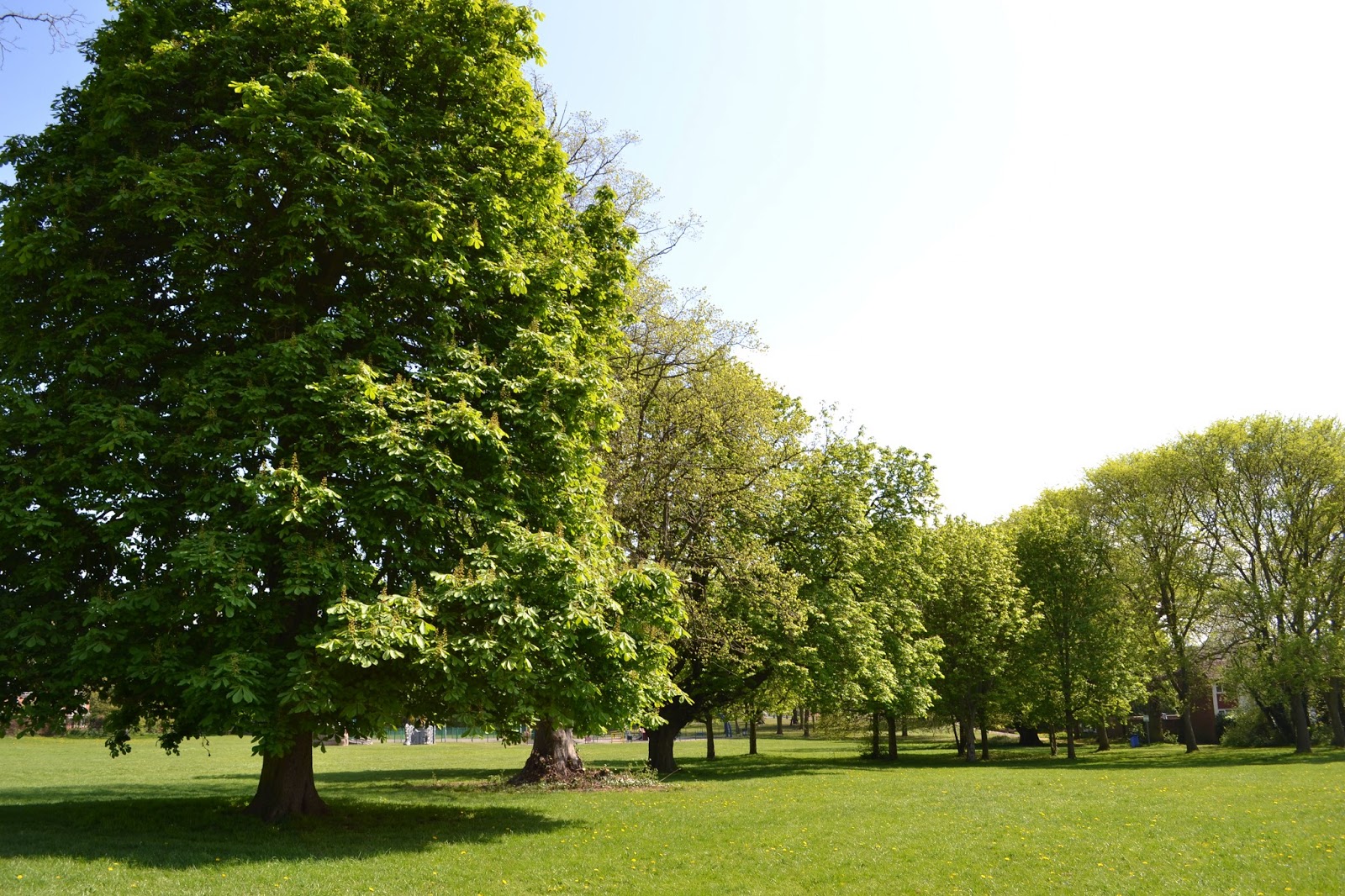
| A view of the park with trees, grass and blue sky! |
Way back in the 18th Century Tamworth Town Clerk Charles Oakes (which is such an apt name considering the tree trail) had a farm here, but by the early 19th Century the land was owned by John Clarke, who was a top surgeon specialising in women’s diseases. He and his wife Elizabeth built a small mansion there (today it is known as Wigginton Lodge, and is the headquarters of Tamworth Rugby Club), as well as a lodge and a farmhouse, both of which have long-since vanished. The estate was later inherited by John Clarke’s brother Charles, an even more famous surgeon, who also specialised in women’s diseases and must have been very fashionable and highly respected because he was personal physician to Queen Adelaide, wife of King William IV, and was made a baron in 1831 in recognition of his services to womankind.
Anyway, it was John and Elizabeth who created a 45-acre park on the site, with grass and trees – some imported from abroad at great expense. Amazingly, the area has survived changes in ownership, and modern development (which destroyed an awful lot of old Tamworth) and is now a public park, which includes rugby pitches and a play area for children. And at its heart are the trees, featuring some planted by the Clarkes 200 years ago.
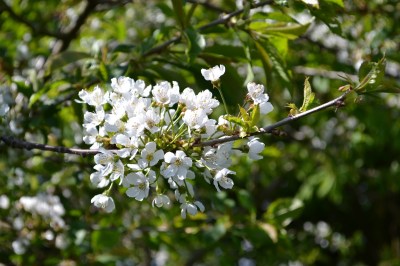 |
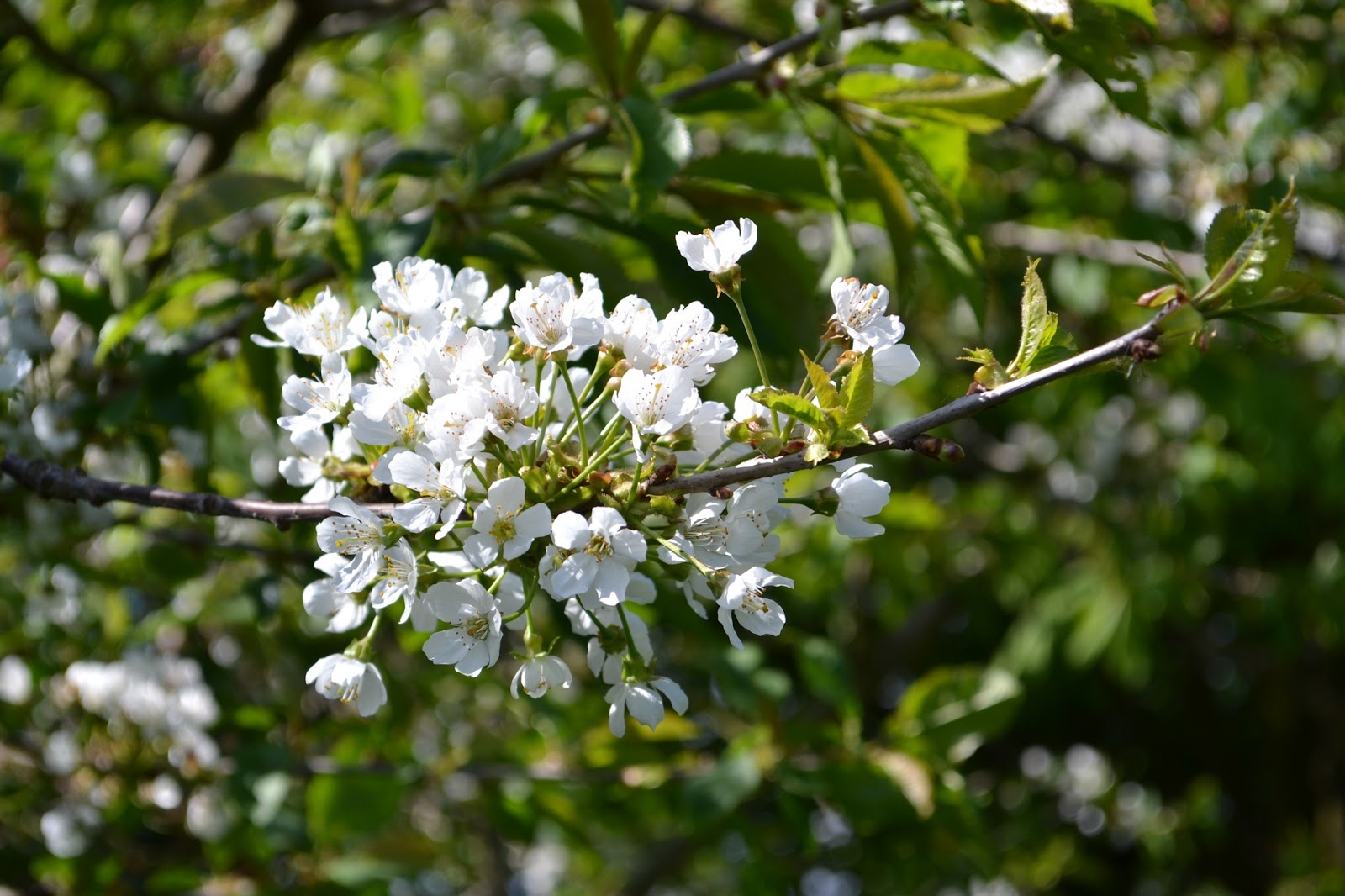
Bloom along the bough… Trees and bushes were laden
with blossom in shades of pink and white. |
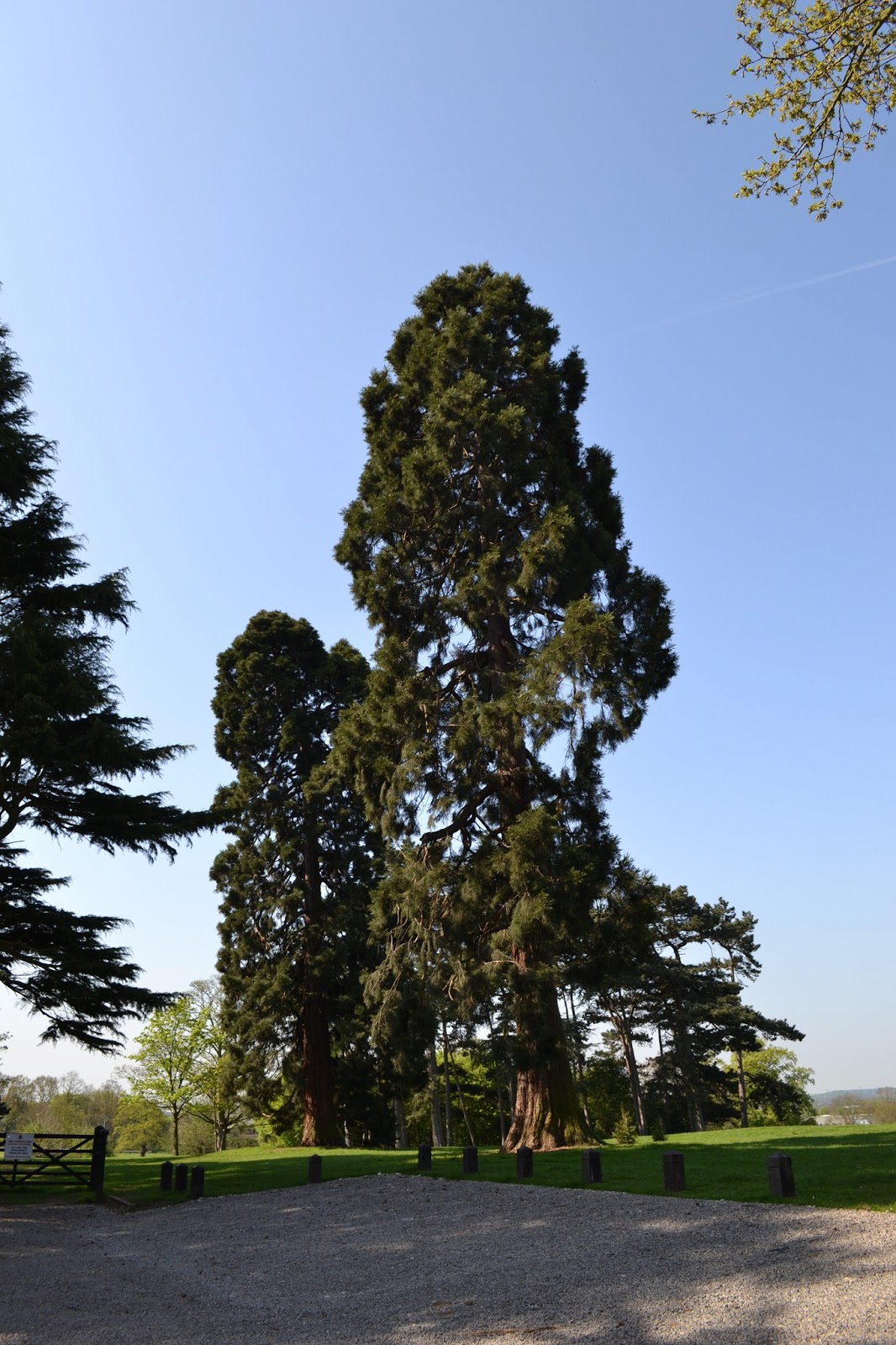
My favourites were probably the two Giant Redwoods which, despite their size, have strange, spongy bark which is soft like cardboard – so said the online guide (Elder Daughter’s mobile came in handy again!) and we felt the bark, and the information was spot-on. Apparently the bark protects the trees from the intense heat of forest fires in the Sierra Nevada mountains of California, which is the place they grow naturally. Isn’t that a wonderful example of the way evolution ensures plants are perfectly adapted to their habitat? And how incredible to think that a tree native to that one special environment can still flourish here in damp, cold England!
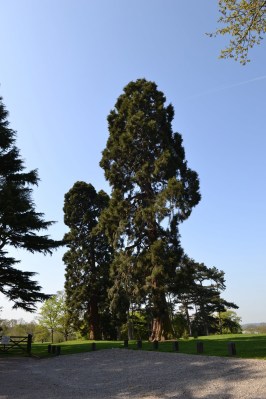 |
| What a whopper! This should be Sequoiadendron Giganteum. |
I was so intrigued I looked them up and discovered Sequoiadendron Giganteum (also known as (Wellingtonia) are the world’s largest trees. The bark can grow up to three feet thick, and they can survive for several millennia – apparently one recorded specimen is 3,500 years old. Europeans first came across them in 1830, but it wasn’t until the 1850s that plant collectors started to bring seed back to the UK, so park founders John and Elizabeth obviously never knew about this species, but I’m sure they would have liked the idea of something new and exotic becoming a feature at their old home.
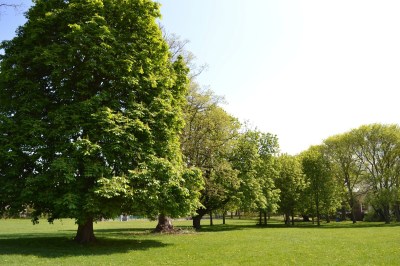 |
| Chestnut Avenue: Trees still mark the line of the old driveway. |
Landmarks include ‘Bomb Holes’, which are almost certainly where people extracted clay and marl, and are nothing to do with war. These days they’re full of trees, bushes and flowers, providing perfect sites for nesting birds and sheltered homes for other wildlife. In addition there are little woodland copses, and the remains of the old avenue of trees that once lined the main driveway to Wigginton Lodge, where you can see the ridge in the ground where the drive was, though it does not photograph all that clearly.
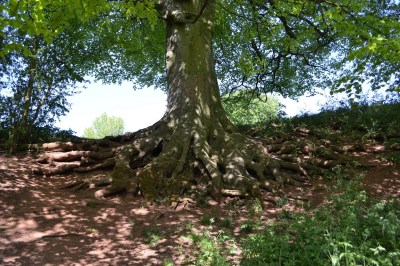 |
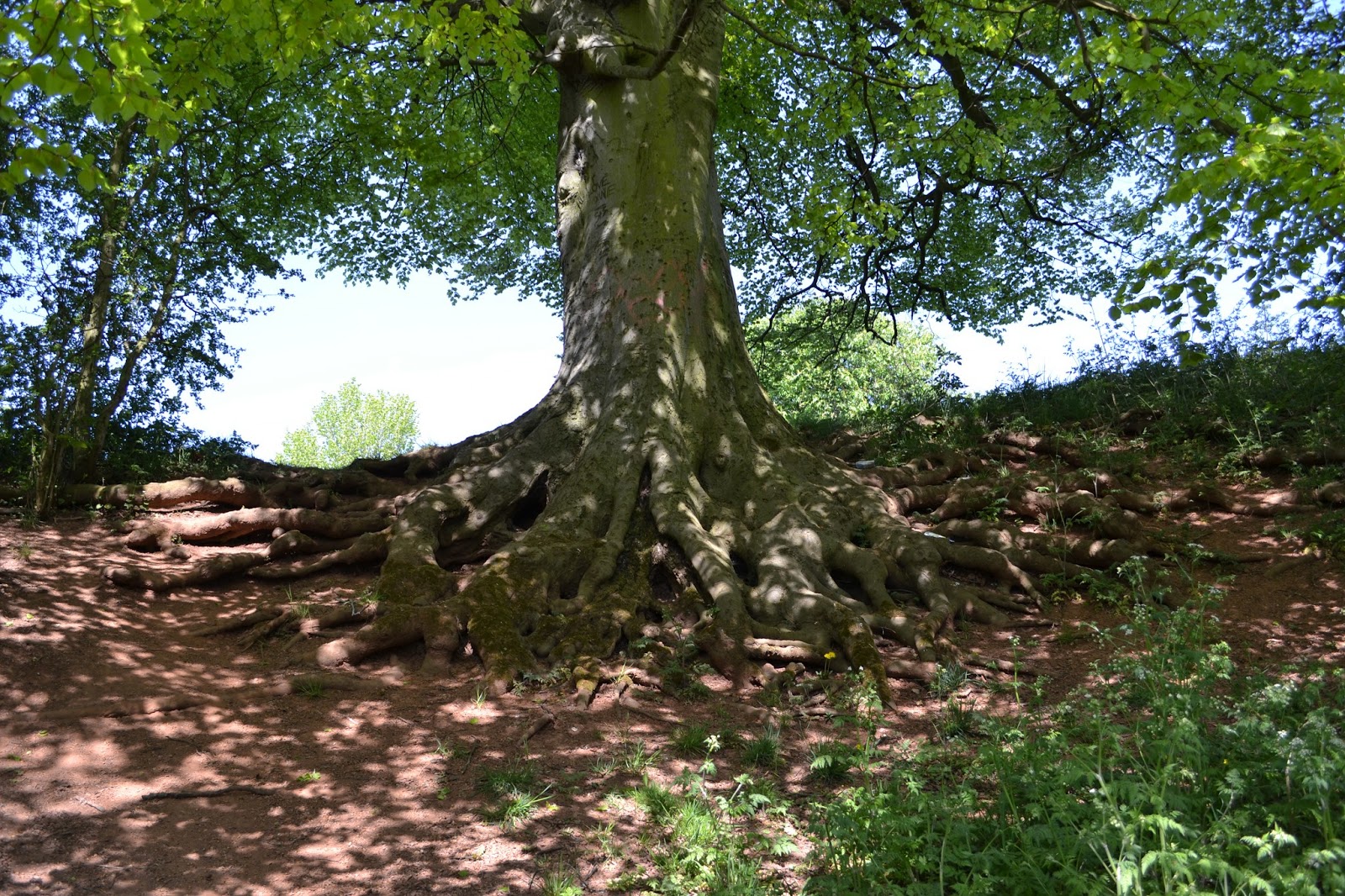
I loved the roots and dappled shade of this tree, perched up on the edge
of a ‘Bomb Hole’ that owes its existence to quarrying rather than war. |
We spotted the Holm Oak, a native of the Mediterranean, with leaves that look like holly (that’s how it got its name, because holm is thought to be the Anglo Saxon for holly). And we recognised a dead elm, and saw the marks left by ambrosia beetles which bored into the trunk. The beetles are not as heavenly as they sound, for they were responsible for the spread of Dutch Elm Disease, which killed this tree, along with thousands of others throughout England. The dead tree has been left to provide a habitat for flora and fauna, which seems a good idea.
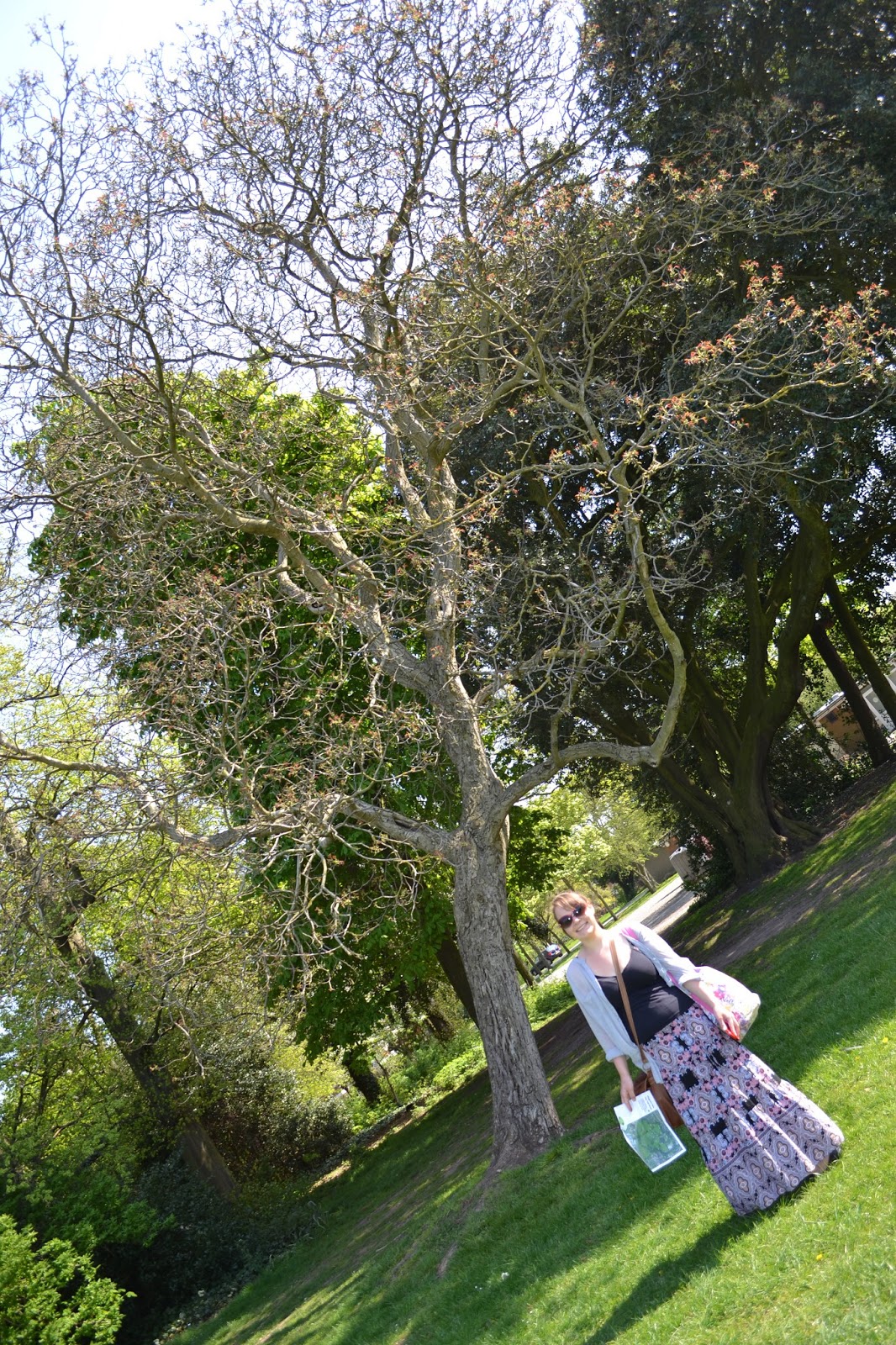
And there’s a walnut tree, looking as if it’s on its last legs, but apparently its roots are strong so it is healthy, despite the drunken angle it stands at! We were interested to learn that because walnuts look like brains, Greeks and Romans believed they cured headaches, and whilst I can’t vouch for the truth of that it sounds a pretty good reason for eating walnuts, which are delicious.
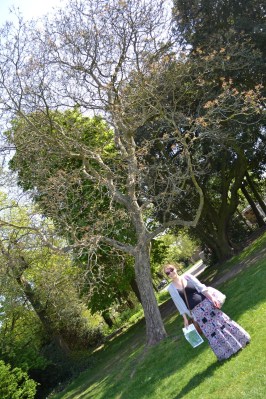 |
Elder Daughter says this is the walnut the tree, and she was the
Electronic Map Reader, so I hope she’s right! |
I wanted to try out a bit of Natural Navigation, as advocated by Tristan Gooley, but we had quite enough trouble trying to follow the map (an aerial photo which looks quite different to the way things are on the ground) and identifying trees. The details and photos on the websiteare excellent, but if you not an expert it is incredibly difficult trying to decide which tree is which. Consequently, although I took lots of photos, I still have no idea which trees they show! Obviously, it’s always tricky balancing the needs of visitors against the need to protect and conserve the environment, but simple, numbered wooden posts would help – or, better still, get local sculptors and artists involved to design waymarkers. And a display board near the main entrance (the one promoted on the website) would be good.
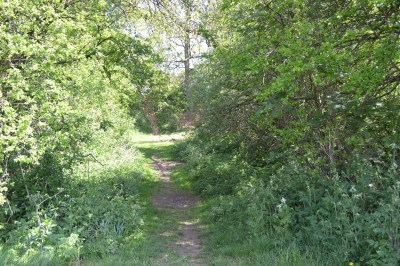 |
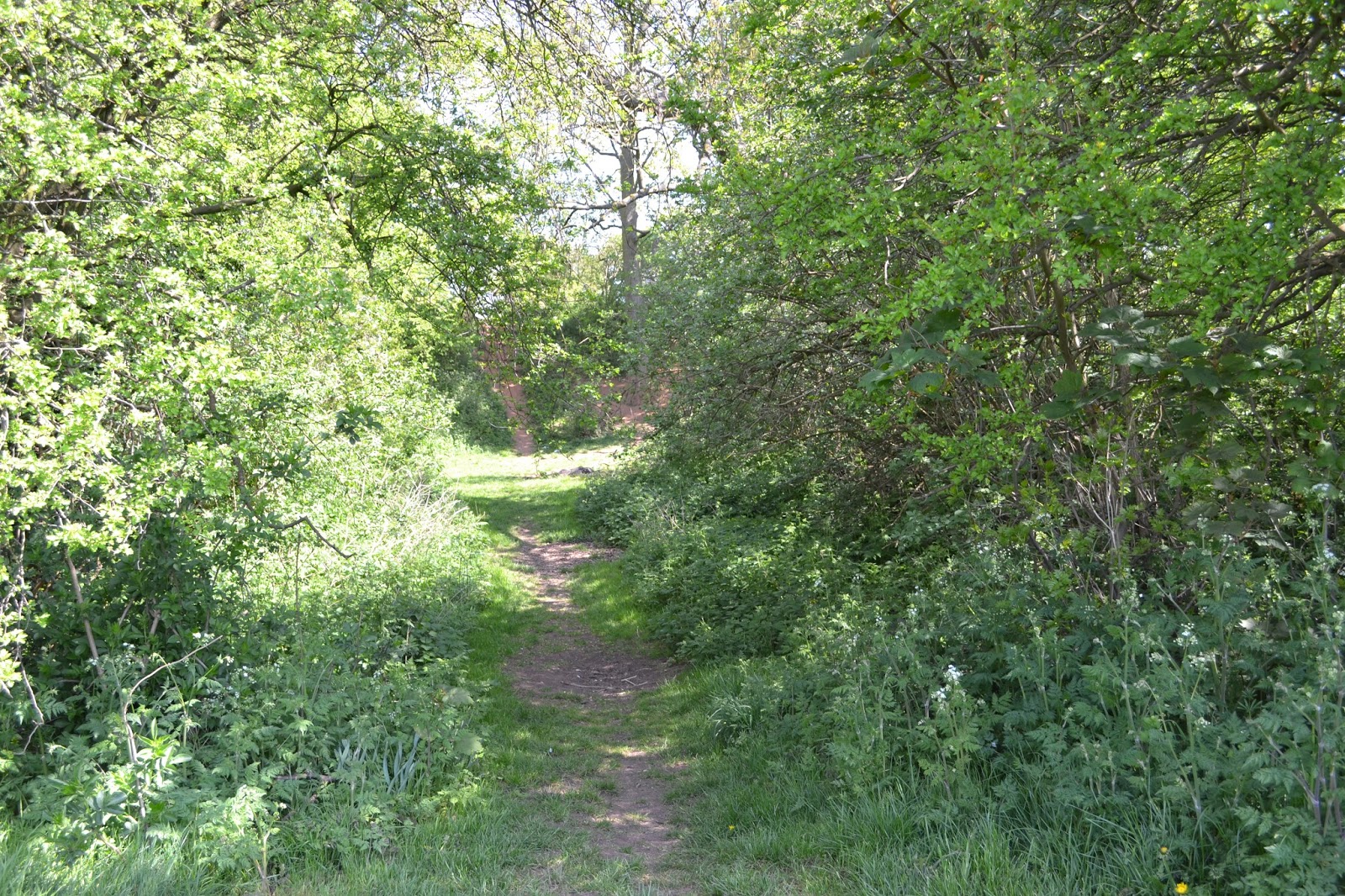
| The road through the woods… |
However, I shouldn’t complain because it was a wonderful morning, and I’ll definitely go back – armed with a print-out of the map, photos and information and a book on trees!
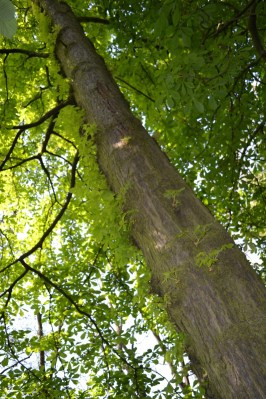 |
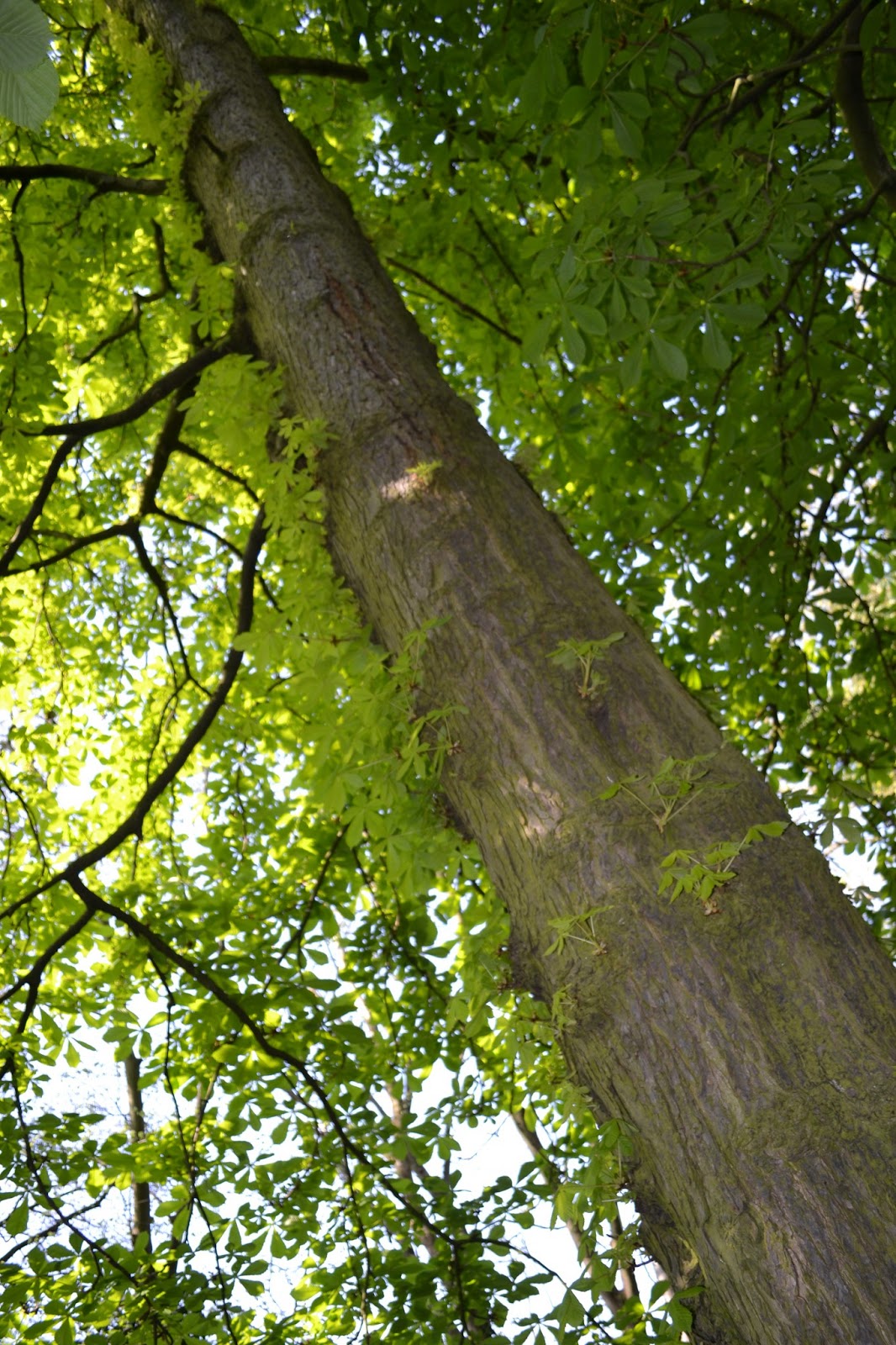
| Trunk call… Looking skyward! |
There’s an ongoing programme of planting, improvement and management at Wigginton Park, and a volunteer Friends group carries out work under the the Wild About Tamworth initiative, funded by site owner Tamworth Borough Council, and Staffordshire Wildlife Trust, so full marks to them all for giving us such a lovely, enjoyable spot, which deserves o better known – but if more people used it, then it wouldn’t be as peaceful as it was during our visit.
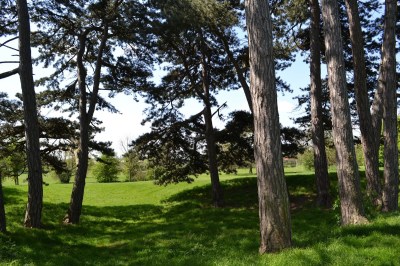 |
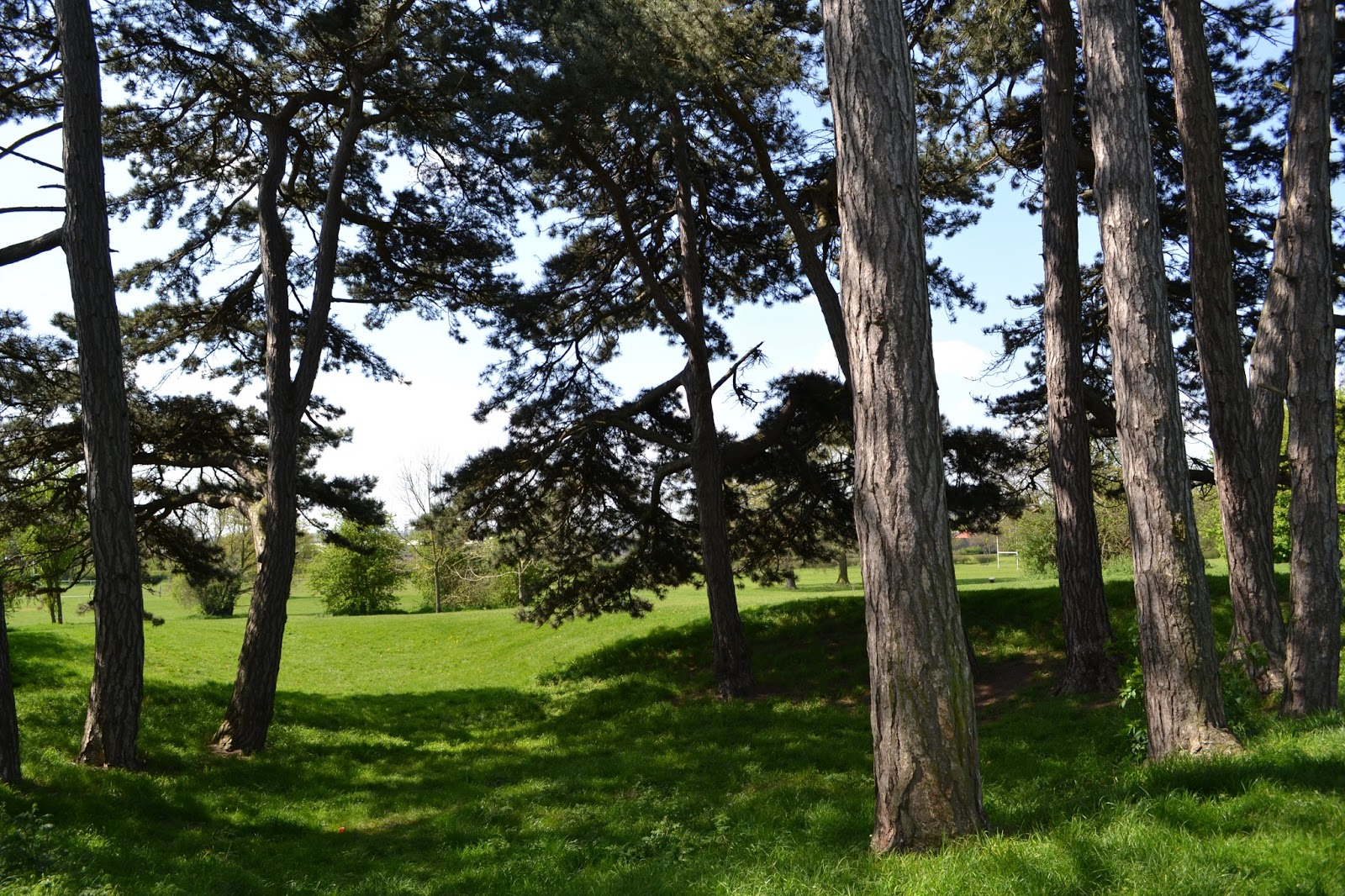
| Little Fir Trees… Well, not so little really, since they are very tall conifers… Scots Pines I think… |

 The Book Trunk
Leave a reply to Lmkazmierczak Cancel reply