 |
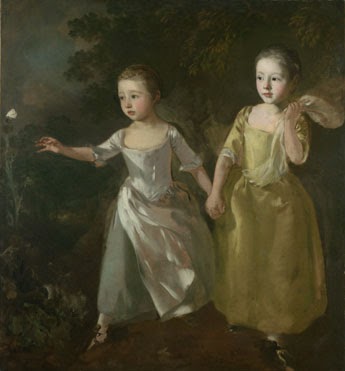
| I’m not sure if a Gainsborough portrait of Arminella Blount in the character actually exists, so here’s his painting of his daughters chasing a butterfly. |
This week a short story much more to my taste – A View of Exmoor, by Sylvia Townsend Warner, whose work I adore. Here the Finch family, dressed in their best, are off to a wedding in Devon, for Mrs Finch’s niece, Arminella Blount, is getting married. They make, says STW, a very ‘creditable’ contribution. Returning home, they’re still clad in their glad-rags: Mrs Finch in green moiré, Mr Finch is his ‘black-and-grey’, 12-year-old Arden looking pale and ‘owl-eyed’ in his Eton suit (he’s had measles), and Cordelia and Clara in their bridesmaids’ dresses ‘copied from the Gainsborough portrait of an earlier Arminella Blount in the character of Flora’. They also have Arminella’s piping bullfinch and the music box needed to continue its education, as well as the bridesmaids’ bouquets.
It was born in on Mr Finch that other travellers along the main road were noticing his car and its contents more than they needed to, and this impression was confirmed when the passengers in two successive charabancs cheered and waved. Mr Finch, the soul of consideration, turned in to a side road to save his wife and daughter the embarrassment of these public acclamations.
Actually, I suspect it is Mr Finch who is embarrassed by his family, and they’re about to get a whole lot more noticeable. He can’t find the map, and has no idea where he is, but he drives on and on across Exmoor, until they stop to look at the view and have a picnic. At this point Mrs Finch recounts a strange and seemingly pointless tale of Aunt Harriet’s ‘inexplicable’ boots, spotted by Aunt Harriet and her brother when they were children in an empty, open, horse-drawn cab on Exmoor. The duo continued their walk, and saw another pair of boots, on the ground by a sulky-looking man and a crying woman, who snatched up those boots, ran back to the cab, and off it went, leaving the man behind. The people were both wearing boots, and the strangest thing of all, says Mrs Finch, was that the woman had no hat.
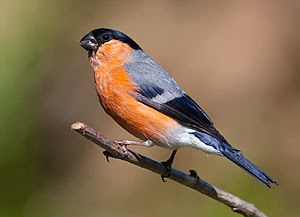 |
| A bullfinch – in case you don’t know what they look like! |
Explanations for this odd story keep everyone happy and entertained, and things seem more or less normal – but this is STW, and nothing is ever normal! Arden is playing tunes on the bars of the bullfinch’s cage when the door flips open and the bird flies out, and they all rush around trying to catch it. Arden falls out of a tree and makes his nose bleed, and they all get more and more dishevelled. Eventually they heave the music box out of the car, hoping that if the escapee hears the music he will come back.
The music box weighed about fifty pounds. It was contained in an ebony case that looked like a baby’s coffin, and at every movement it emitted reproachful chords. On one side it had a handle; on the other side, the handle had fallen off, and by the time the Finches had got the box out of the car, they were flushed and breathless. His groans mingling with the reproachful chords, Mr Finch, staggered up the lane in pursuit of the bullfinch, with the music box in his arms.
Isn’t that a wonderful image? I just love the description of the music box, which is not one of the flimsy, pretty, little trinkets we know today. No, this is a solid affair (my maths isn’t good, but I reckon it’s roughly as heavy as 25 bags of sugar) and its colour and shape, and the ghostly noises it produces (playing chords of its own accord) make it seem rather sinister. But Mr Finch is ‘devoted’ to music boxes – which makes him sound a lot less conventional than he’d have his believe. I know this is set in 1936 (and written in 1948), but even then I’ll bet there weren’t too many family men with a thing for music boxes!
So, while his wife and children rush off, still searching for the missing bird, takes a moment’s ‘repose’, sits on the ground, plays some music, and lights a cigar. Then, he realises they have company – a young man whose ‘bare ruined legs and rucksack suggested that he was on a walking tour’. And at that moment:
Around the bend of the lane came two replicas, in rather bad condition, of Gainsborough’s well-known portrait of Arminella Blount in the character of Flora, a cadaverous small boy draped in a bloodstained Indian shawl, and a middle-aged lady dressed in the height of fashion who carried a bird cage.
The young man on a walking tour continues his journey, skirting nervously round this apparition, and Mr Finch is mortified that his family, away from his ‘supervision’, have once again made themselves conspicuous. He thinks his wife should have explained the situation to the young man. But she says:
He looked so hot and careworn, and I expect he only gets a fortnight’s holiday all the year through. Why should I spoil it for him? Why shouldn’t he have something to look back on in his old age?
That made me smile, and I thought she’s absolutely right. By saying nothing she’s given something to that young man that he’ll remember for ever more, and I could imagine him at some stage in the future telling his children and grandchildren, and everyone sitting around trying to make sense of the mystery, using their imagination to tell stories which create possible explanations… Murder perhaps, madness, ancient rituals being re-enacted. And would anyone have believed the truth if they’d heard it?
And I thought back to Mrs Finch’s story about Aunt Harriet’s boot, where everyone had their own idea about what might have happened, because nothing is ever quite as it seems. So there are issues here about truth and reality, just as there are in many of the other pieces in The Persephone Book of Short Stories, but I also see this as a real celebration of the power of storytelling, linking up with old oral traditions.
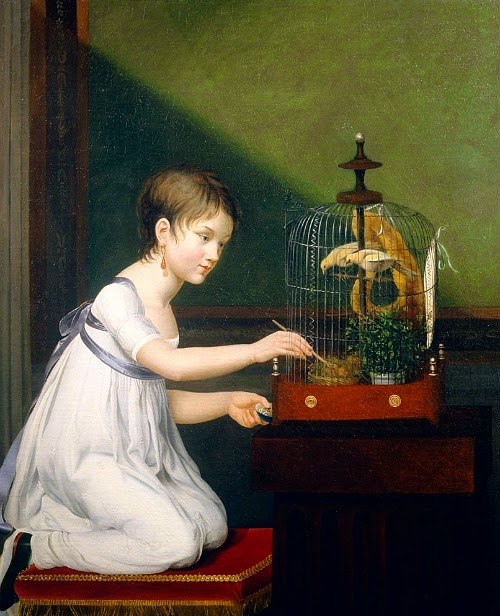 |
| I like Jeanne Elizabeth Chaudet’s picture Young Girl with a Birdcage. It was painted in the late 18thC, and her career overlapped Gainsborough, so the cage may be similar to the one in the story. |


 The Book Trunk
Leave a reply to Nomey Cancel reply