Well, it’s a very long time indeed since I’ve posted anything here – almost a year in fact, and I’m not sure why. I just reached a point where I felt I’d had enough of writing and blogging, and where writing about books, and reading other people’s reviews, seemed to have somehow become more important than reading the books themselves, and that’s the thing I’ve always enjoyed. I felt I needed a break, and never intended to stay away so long. I have missed writing, and missed the interaction with all you other bloggers, but the longer I left it to reconnect with the blogging world, the more difficult it seemed to make a start. However, during my absence I’ve still been reading, and recently I’ve even started scribbling notes in the margins once more, so here I am again, trying to take things very gently, and I’ll just see how it goes.
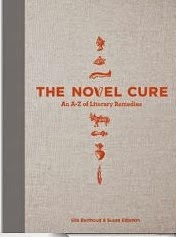
To start with, here are some thoughts on The Novel Cure: An A-Z of Literary Remedies, by Ella Berthoud and Susan Elderkin, which seems to be an apt sort of volume with which to take up my pen again.
 |
| Reading is good for you! |
Much to my delight, there is actually an entry for ‘blocked, being’, which offers two alternatives – constipation (which I didn’t pursue), and writer’s block, which looked more promising, and so it was. The suggested remedy for this particular condition is Dodie Smith’s ‘I Capture the Castle’, one of my all-time favourites. Excellent, I thought, though I’ve always seen it more as a rites of passage novel, but yes, there is a writer who can no longer write, and yes, he is cured though, as the authors of this volume admit, Cassandra’s methods are a little extreme (she shuts her father in the tower of their castle home), and should not necessarily be copied.
In any case, that would be difficult since we have no tower. But the Man of the House spent the summer building me a little shed, where I mess around with my arty-crafty bits and pieces, instead of strewing them around the house. So I have shut myself in, with my laptop (to write on – or should that be write with?); a wireless (I like to listen to Radio 4); a pot of tea (to lubricate the brain cells); some cake and biscuits (I deserve a treat), and a woolly blanket (to keep me warm). I could just sit and read, or do some crochet, but I have promised myself I will write something, so here goes.
Personally, I don’t think The Novel Cure should be read straight through, from A to Z via B,C,D etc. It’s a book meant for dipping in and out of. You could make lightning raids, looking up one thing one day, and something entirely different another. Or – and this is my favoured method – you can enjoy a long, meandering rootle through the pages, where one thing leads to another, and that other leads to something else, and so on, and on, and on.
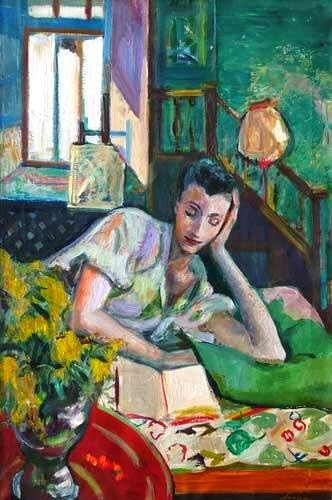 |
| A Duvet Day… Woman Reading in Bed, by FB Serger (1889-1965). |
For example, I looked up ‘adolescence’, reacquainted myself with Holden Caulfield, then followed the thread for ‘bed, inability to get out of’ which turned up ‘Bed’, by David Whitehouse. Somewhere along the line I ended up with PMT, where I wallowed in the comfort of ‘Ten Best Novels for Duvet Days’, which I think is a lovely notion. Perhaps we should all have regular duvet days, when we curl up in bed and do nothing but read! From there it was a short hop and a jump to ‘headache’ and a lovely little haiku, ‘Snow’, by Maxence Fermine, who I’d not come across before, so I looked him up, and assume the poem comes from the novel of the same name. At any rate, as I read I could almost feel the temperature drop, and I swear a cooling wind chilled my forehead. See what I mean about one thing leading to another…
 |
| Romance in a hammock… A Love Story, painted by Emanuel Phillips Fox in 1903. |
Skip on a little from ‘headache’ and you find ‘holiday (not knowing what novels to take on)’ which is a problem many of us will recognise. The solution, according to Berthoud and Elderkin, is careful planning – and the Ten Best Books to Read in a Hammock. Actually, I must confess that worries me – not the books, you understand, but the hammock. A hammock always looks so romantic, but how comfortable would it be in reality? And how does one clamber in and out? I have horrible memories of being unable to arise from a deckchair in Hyde Park, much to my Younger Daughter’s chagrin. Thankfully, there’s no Novel Cure for ‘embarrassment, caused by parents’, but I wouldn’t want a repeat performance. Most worrying of all from my point of view, would the hammock swing and sway, and if it did would I be seasick… And if I was, what would the cure be…
It turns out that the closest match for that ailment is carsickness, and the authors very sensibly suggest rail journeys instead, and even provide the names of Ten Best Novels to Read on a Train! It’s sound advice I think, since trains are the only form of transport which don’t make me ill, and I always curl up with a good book.
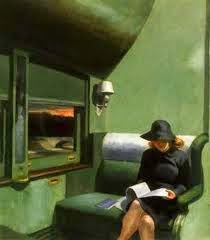 |
| Reading on a train… Edward Hopper’s iconic painting, Compartment C, Car 293. |
Now, it should be emphasised that if you’re unwell these bookish ‘prescriptions’ will not cure you (and the authors never say they will), but they will almost certainly make you feel better. Some are feel-good books, with happy endings, others show how characters cope in difficult situations, and a few are bleaker, edgier novels, which leave you counting your blessings because things could be worse.
There’s a good mix of books, from ancient classical works like ‘The Odyssey’ (good for ‘itchy feet’, should you wonder) to 19thCentury classics and 21st Century authors, with plenty of foreign writers and a few children’s stories. You’ll probably find some old favourites here, but you won’t have read all the books suggested, and even if you have, you won’t like them all – and you may disagree with some choices, or think of novels that ought to have been included. But that’s half the fun with a book like this, and there’s nothing to stop you making your own lists and ‘remedies’.

 The Book Trunk
Leave a reply to lyn Cancel reply