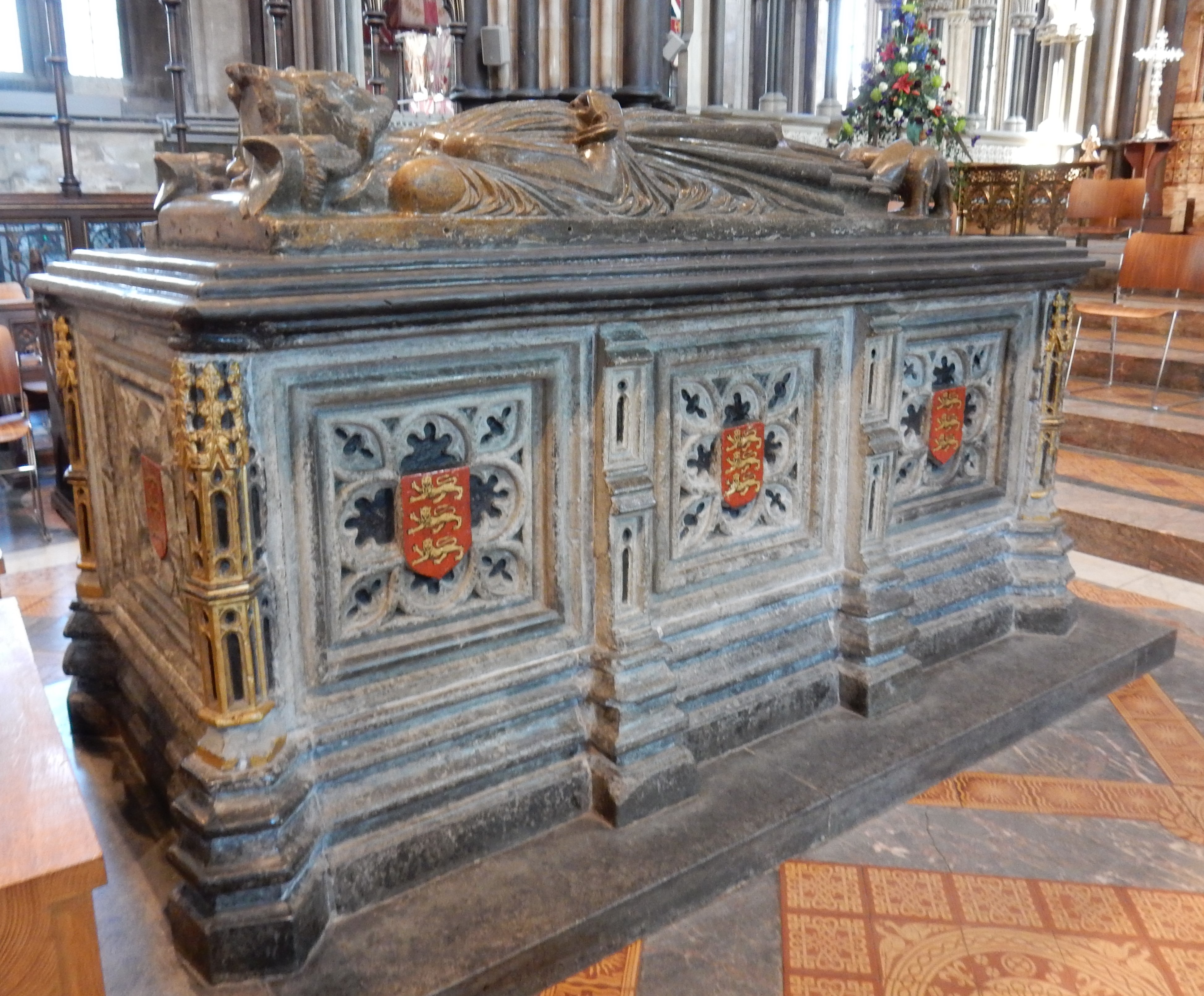
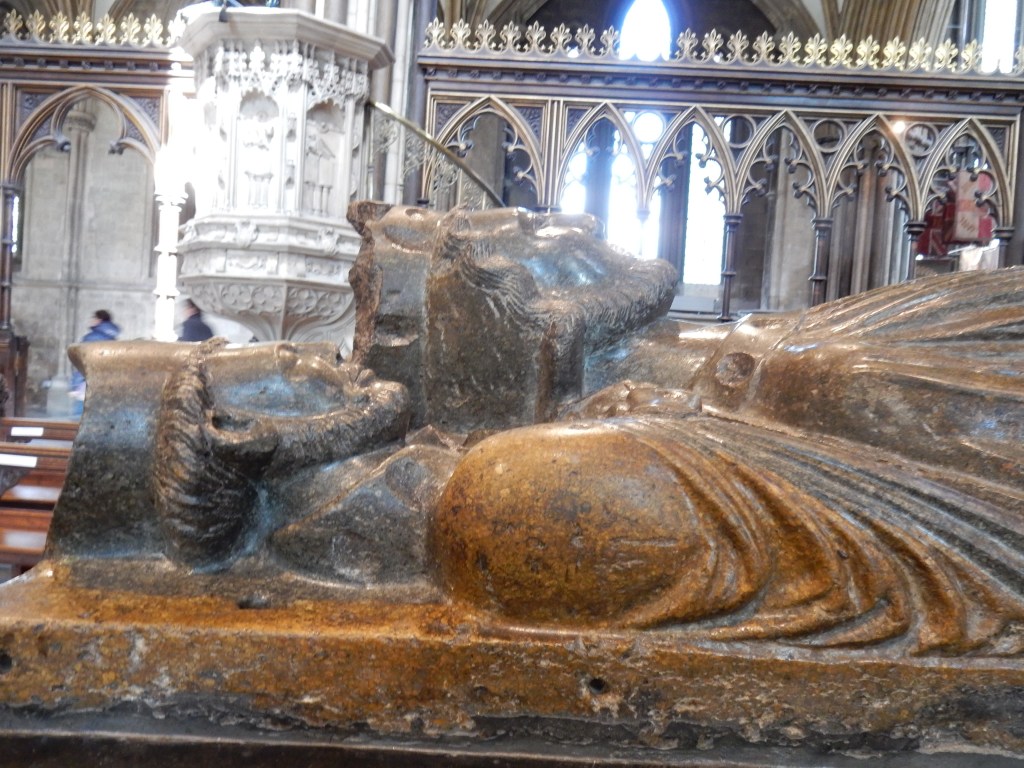
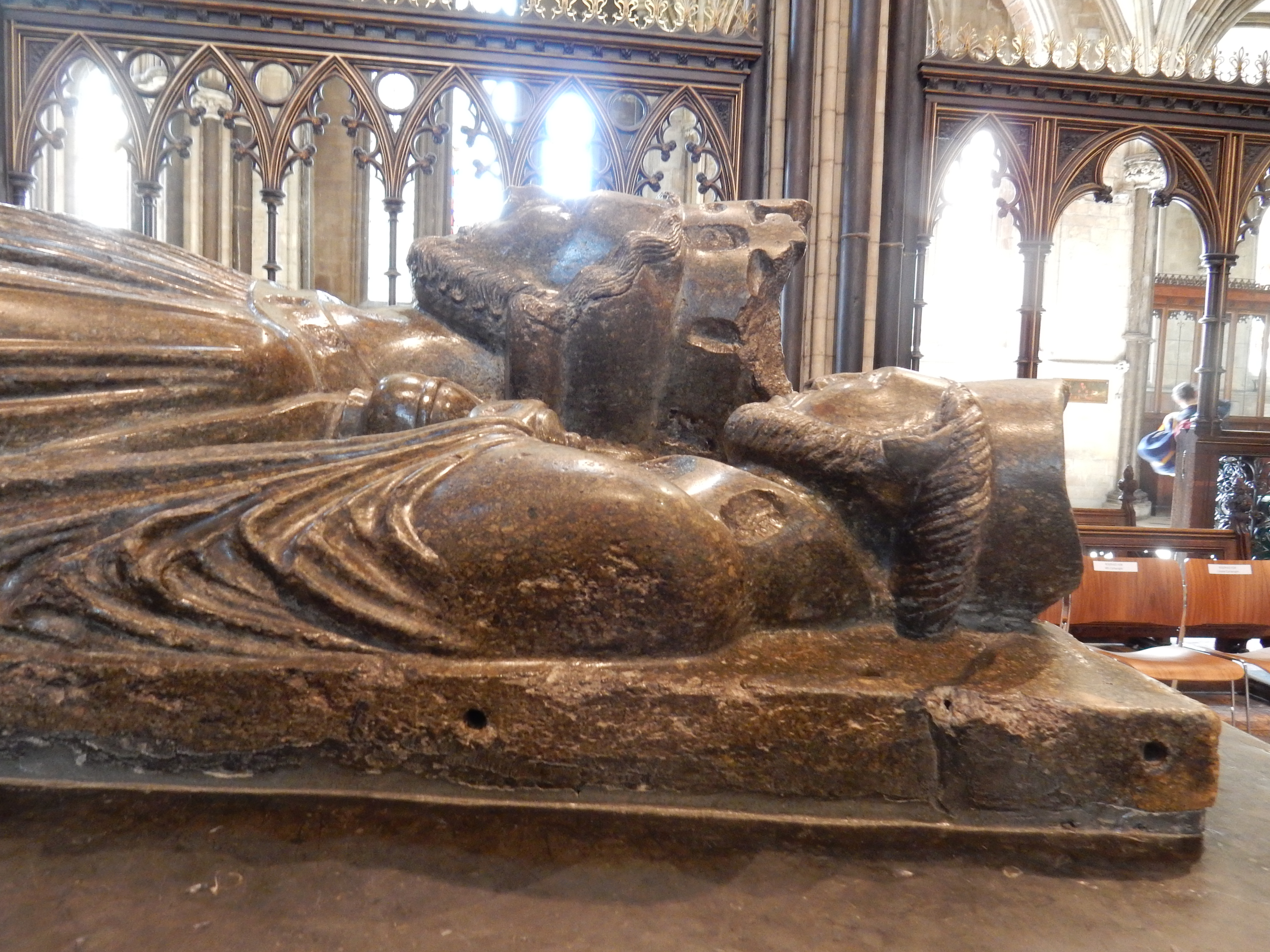
This week’s Saturday Snapshot photos were taken during a recent visit to Worcester Cathedral, and show the tomb of King John – think Robin Hood (only that turns out to be just a story), Magna Carta, and Crown Jewels lost in the Wash.
These days there’s a tendency for historians to take a revisionist view of the past, so figures once considered bad turn out out to be good (and vice versa). King John, however, remains an unreconstructed villain. He had few supporters in his own time, and the general view of him as a thoroughly bad lot and very unpleasant person has stayed largely unaltered in the 800 years since his death.
I’ve always been interested in him because when I was a child we lived at Egham, and that’s where Runnymede is – the meadow by the River Thames where Magna Carta was sealed on June 15, 1215.
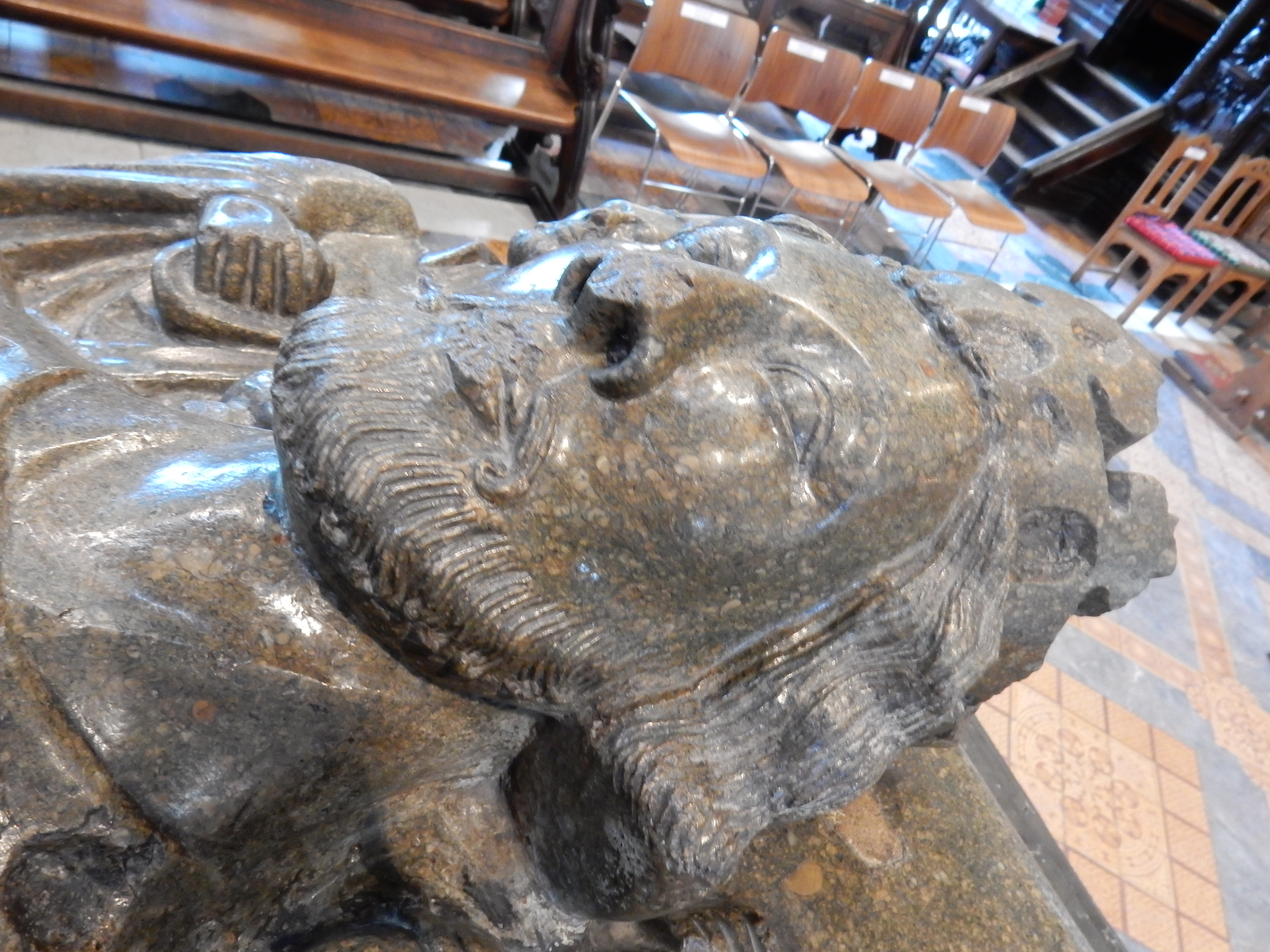
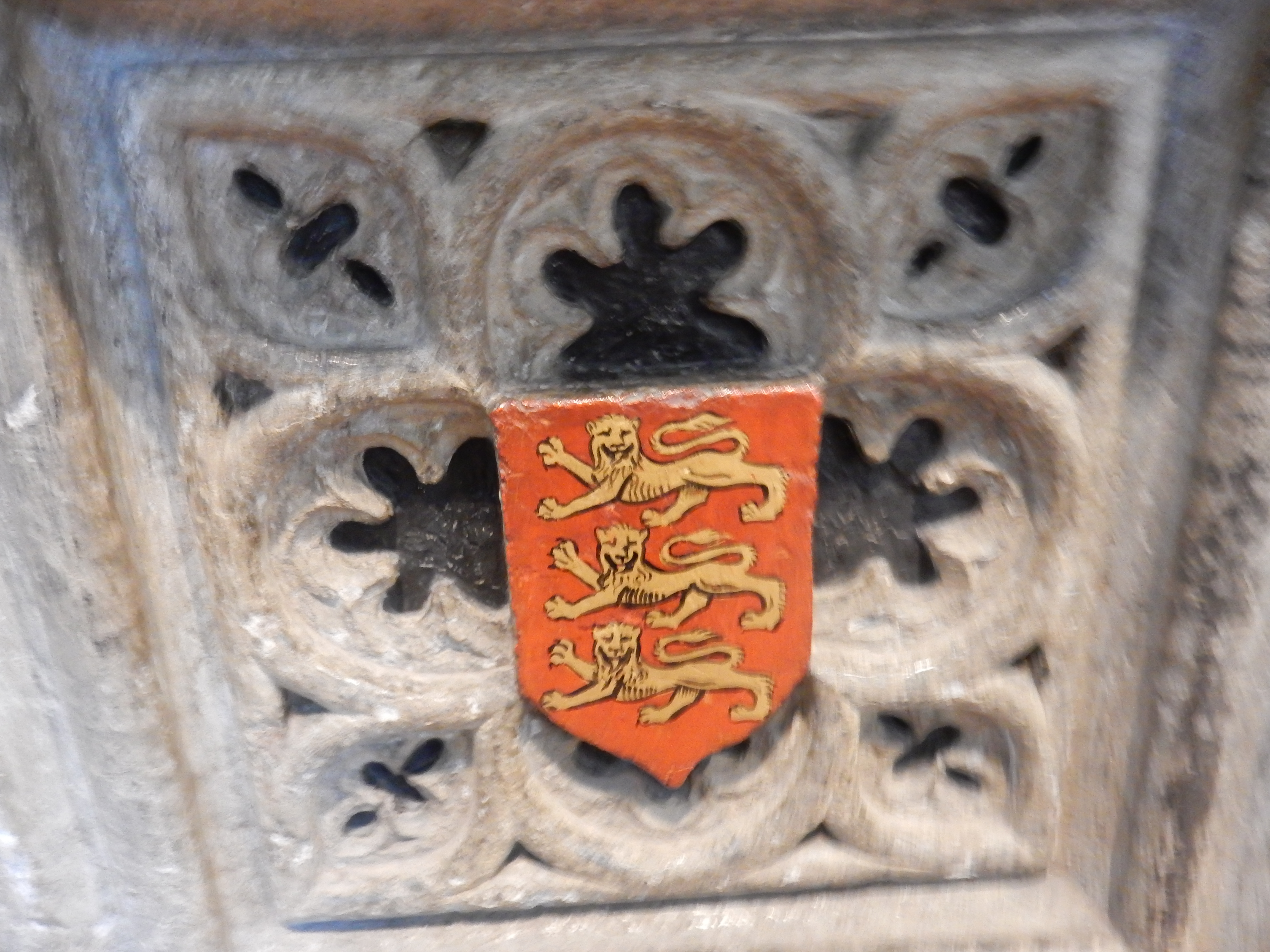
I have to say that the tomb is not as grand as I expected, but I guess that’s because it’s got a little worn over the centuries. Originally, I think it would have been painted with bright colours and would have shone with gold. However, some of the gilding is still there, and there are red and gold shield-like plaques showing the royal lions of England, so you get a sense of what it must have been like, and you know the body of a king is buried here.
The tomb is in front of the High Altar, and there some excellent information plaques in the cathedral, but I am a little confused as to which bits were installed when. There must have been an earlier tomb, because the effigy and a new sarcophagus were ordered by John’s son Henry III in 1232, but it was opened in 1529 when, according to the cathedral website, the box part was added (there is a stone coffin inside it). And it was opened again in 1797 for an ‘antiquarian study’ of the body, which sounds grisly. On that occasion someone took a thumb bone and two teeth from the body. I saw the teeth at Worcester Museum, and was surprised at how large they were, and how yellow, but I couldn’t get a picture. Like I just said, grisly!
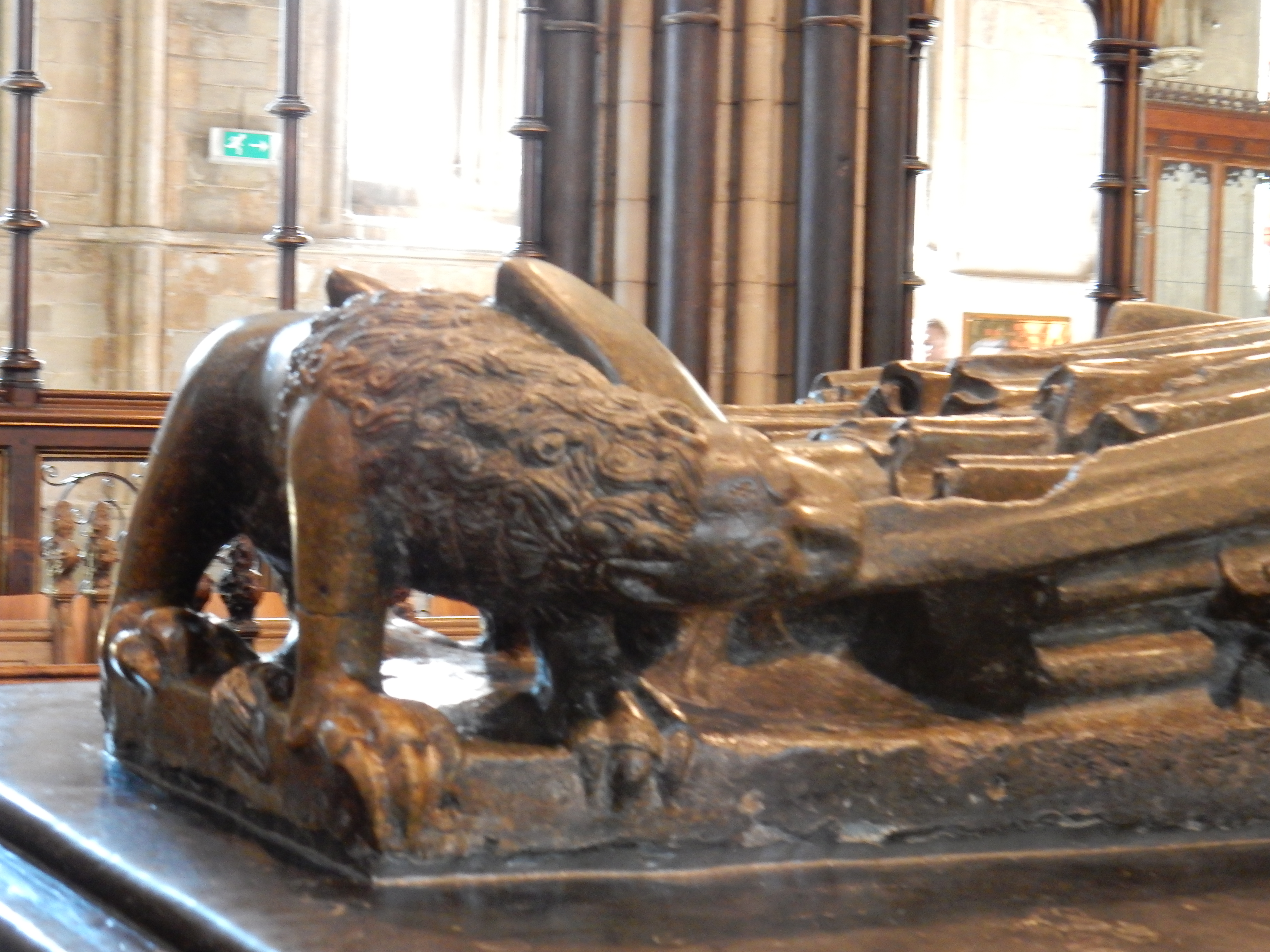
Anyway, I digress. On his tomb King John is shown carrying a drawn sword which apparently, is very unusual, since swords on tombs are normally sheathed. And the tip of the sword is in the mouth of an animal at the the king’s feet. Now I thought this was a dog, but when I got home I watched a repeat of the BBC programme The Last Journey of the Magna Carta King (first broadcast last year), and the experts on that said it’s a lion, which is not common on tombs, and they got terribly excited, and said it’s all very symbolic, and I just wish I had taken a few notes so I could understand what they were talking about!
And there’s more symbolism at the other end of the tomb, because there’s a small carved head on each side of John’s crowned head. And I must be some kind of Philistine, because as I looked at them all I could think of was Zaphod Beeblebrox! If you’ve never come across him, he’s the former President of the Universe in Douglas Adams’ Hitchhiker’s Guide the Galaxy, and he has two heads…
Anyway, I digress (again). One of the little heads at John’s side is St Wulfstan, and the other is St Oswald, but I have no idea which is which. They look as if they are perched on John’s shoulders, so their heads are taller than him, although they are smaller. I’m not sure if saints take precedence over kings, which puts them on a higher level than John, or whether they are simply offering protection as they gaze down from heaven. Personally I find them a bit spooky, but there we are. Everyone has different tastes. Apparently Wulfstan and Oswald were John’s favourite saints, with major shrines in Worcester, which may explain why he chose to be buried there.
John died unexpectedly, and was buried in a hurry. Events during the final few days of his life seem confusing. By October 1516 civil war had broken out and the rebel barons, who held huge swathes of the country, had invited Louis of France to take the throne of England. John marched east towards rebel strongholds in Lincolnshire and East Anglia, but was taken ill, probably with dysentery. As his condition worsened he turned towards Nottinghamshire, taking a longer, safer route, while his baggage train – reputedly carrying royal treasure which included the crown jewels – followed a shorter route across the treacherous sands of the Wash… And I’m sure you all know what happened next…
Precise details are unclear, but men, animals, wagons and treasure all disappeared, sucked beneath the quicksand, or swept away by the incoming tide. The exact location of the disaster remains a mystery, and no-one has ever found any trace of the lost treasure.
John travelled as far as Newark, where he died on October 18 or 19 (accounts vary). Shortly before his death he dictated a brief will, which is kept in the library at Worcester Cathedral. It’s the oldest royal will will to survive in its original form, and is kept in the cathedral library. In it John outlined the way his kingdom should be ruled during his son’s minority (Henry was just nine years old when John died), and stated: “I will that my body be buried in the church of St. Mary and St. Wulfstan of Worcester”.
According to the cathedral information boards John died in agony, and his servants ran away, taking everything they could carry. Next day the monk John de Savigny found John’s naked, unguarded body covered with a cloth. He prayed for the dead king, and dressed him in what came to hand. A troop of mercenaries took the body to Worcester, but the king’s heart was buried at Croxton. Soon after his death rumours circulated claiming that he had either been poisoned, or had died of a ‘surfeit of peaches’ (I have no idea what constitutes a surfeit when it comes to peaches, but I dare say eating too many of them could make you very ill indeed). However, modern historians believe he died of dysentery.
Edited, 5.20pm: Realised The Last Journey of the Magna Carta King is on BBC iPlayer, so I watched it again. Apparently the lion on the tomb represents the World, and the damaged sword is the king’s power (it hasn’t been broken by time, but was made like that), and the two things together represent the king dealing with a world in rebellion.Sometimes I wonder if people read too much into things…
*Saturday Snapshot is hosted by Melinda, at West Metro Mommy. Click on the link to see pictures from other participants.


 The Book Trunk
Leave a reply to James M. Dennis Cancel reply