 I have, as they say, been somewhat in the wars in recent weeks. First there was a bad tooth which got infected and the infection spread into my jaw and throat, then there was the lurgy (a bad cough and cold which wouldn’t clear up), then I slipped on an icy step, landed face down on concrete paving slabs, and ended up in casualty having a CT scan to check everything was OK. Fortunately there’s no serious injury, just severe bruising and a lot of pain, but I feel a little sorry for myself!
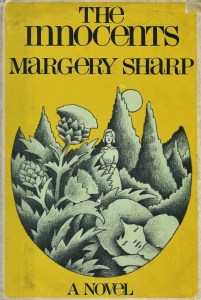
Anyway, today is Margery Sharp Day, the first anniversary in a year-long Birthday Book of Under-Appreciated Lady Authors being run by Jane over at Beyond Eden Rock. So I’m posting a hastily scrawled piece about The Innocents, which I have read before, but never written about. However, it’s well worth reading again. On the face of it, it’s a simple tale, but there’s a darker edge to this than some of Sharp’s other work, and the ambiguous ending leaves you wondering about the nature of innocence, and whether a bad act committed for a greater good can ever be sanctioned.
Telling us about the child, the narrator says: “I have spoken of her, describing our first encounter, as a baby. Antoinette was in fact three. At three, she should have been able to untie my shoe-laces quite easily. She should have not only uttered, but prattled. At three Antoinette had still no more language than – a baby.”
And she is as clumsy as baby, easily frightened, and when she is scared she is sick. But gradually Antoinette comes to trust her elderly carer, a relationship develops between the two of them, and the child is accepted by villagers who ‘do not blame her for being an innocent’. “Spoken to always quietly and slowly, Antoinette understood perfectly. All that was needed was patience,” says the unnamed narrator (I’m sure her name is never mentioned – if it is, I missed it). Later she tells us: “Antoinette slowly but surely developed from a small animal into a small child.”
However, that is all she will ever be – a small child. And a very odd small child at that. She spurns toys and games for things like rabbit droppings, and frogs and toads (alive and dead) and although she acquires some language (tureen, vermin, rucksack, pepper) she cannot communicate. The local doctor says she is retarded (a commonly used word when the book wa written in 1971), not autistic, and she needs lots of TLC – and that’s just what she gets with her aging protector. For the spinster, who has little or no experience of children, accepts Antoinette as she is and has no unrealistic expectations or ambitions for her. She loves the little girl, wants her to be happy, and is willing to let her set the pace.
But their idyll is threatened when the war ends and Cecilia, now widowed, returns to England. She aims to take’Tony’ back to America, and employ an army of specialists to turn her into a normal child – a transformation that, as everyone else realises, is simply not possible.
Antoinette is uprooted from her usual routine and environment to stay with Cecilia at the local hotel. Unable to understand what is happening she loses her joy in life, and retreats into dejected, passive acceptance. And as the day of leaving draws closer the narrator becomes more and more concerned that the future being mapped out for Antoinette is not in the child’s best interests, but there is nothing she can do to prevent it… Then, at the 11th hour fate steps in – or, possibly, is nudged in the right direction…
I loved this. It’s warm and sensitively written, hitting a balance between light-hearted humour, serious issues, and ethical dilemmas, while exploring the problems involved in caring for a child with special needs, a topic that still tends to be overlooked. Additionally, the characterisation is excellent Margery Sharp can establish a personality in very few words, and builds on the picture as the story progresses, with a word here, and a hint there, until the complete person emerges. Margery Sharp is also very good on descriptions, giving a real sense of place so you can build a picture of the locations, as well as the people.


Leave a Reply