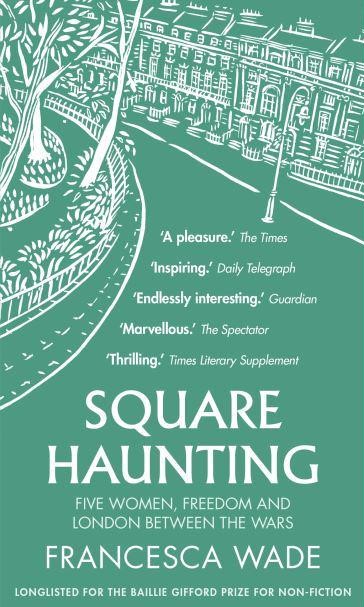
Dorothy L Sayers who I mentioned in my last post, also appears in this one – Square Haunting, by Francesca Wade, which is about five women who broke new ground in their professional and private lives between the First and Second World wars, and all lived in the same London Square (though not at the same time).
Their chosen location was Mecklenburgh Square, on the edge of Bloomsbury – and one of them was Dorothy L Sayers, who moved into a room in the square in 1920, which had once been occupied by imagist poet and writer Hilda Doolittle (known as HD), whose somewhat colourful life also features in the book. Alongside Sayers and Doolittle we meet Medievalist and pioneering economic historian Eileen Power, classical historian Jane Harrison, and novelist Virginia Woolf. In their day, all were renowned for their work, but only Sayers and Woolf have retained their fame, and the other three are all but forgotten, which is a shame, because they’re equally deserving of a place in history but, hopefully, Wade’s book will go some way towards a revival of interest.
She tells us: “Sayers’s greatest novel, Gaudy Night, would turn on the question of how women ‘cursed with both hearts and brains’ might preserve their independence and find intellectual stimulation without relinquishing the pleasures of partnership – a dilemma that occupied all the women in this book.”
And she explains: “These women were not a Bloomsbury Group: they lived in Mecklenburgh Square at separate times, though one or two knew each other, and others were connected through shared interests, friends, even lovers. HD and Sayers lived in the square when their careers had hardly begun, Woolf and Harrison at the very ends of their lives; Power lived there for almost two decades, Sayers and Woolf just one year each. But for all of them, in different ways, their time in the square was formative. They all agreed that the structures which had long kept women subordinate were illusory and mutable: in their writing and their lifestyles they wanted to break boundaries and forge new narratives for women. In Mecklenburgh Square, each dedicated herself to establishing a way of life that would let her fulfil her potential, to finding relationships that would support her work and a domestic set-up that would enable it. But it was not always easy. Their lives in the square demonstrate the challenges, personal and professional, that met – and continue to meet – women who want to make their voices heard.”
That may make Square Haunting sound like a scholarly text book, but it really isn’t, because Wade tells the women’s stories with warmth, compassion and a touch of humour, and she crafts her narrative as if she were writing a novel, so you turn page after page, wanting to more about these women – where they came from, what happened to them after they left square, and what made them the people they were. Wade also tells us a little about the people these women’s world – historians, poets, authors, artists, philosophers, politicians and activitists.
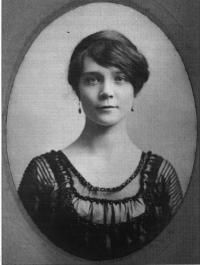
I particularly liked the section on Dorothy Sayers, who created the wonderful amateur detective Lord Peter Wimsey in her room at Mecklenburgh Square. At a time when she was an unknown writer, with little money and few possessions, Sayers (who comes across as being much more fun and subversive than I imagined) derived great pleasure in giving her hero the things she couldn’t afford. She enjoyed spending his fortune for him, and Wade quotes her as saying: “When I was dissatisfied with my single unfurnished room I took a luxurious flat for him in Piccadilly. When my cheap rug got a hole in it, I ordered him an Aubusson carpet. When I had no money to pay my bus fare I presented him with a Daimler double-six, upholstered in a style of sober magnificence, and when I felt dull I let him drive it.”
That made wonder if we’ve all been taking Lord Peter too seriously! But Sayers’ story also made realise how tough life could be for a single woman on a limited income trying to carve out a career for herself, and gave an insight into her reasons for keeping an illigitmate birth secret, having her baby son brought up by an aunt, and passing him off as her nephew when she adopted him many years later.
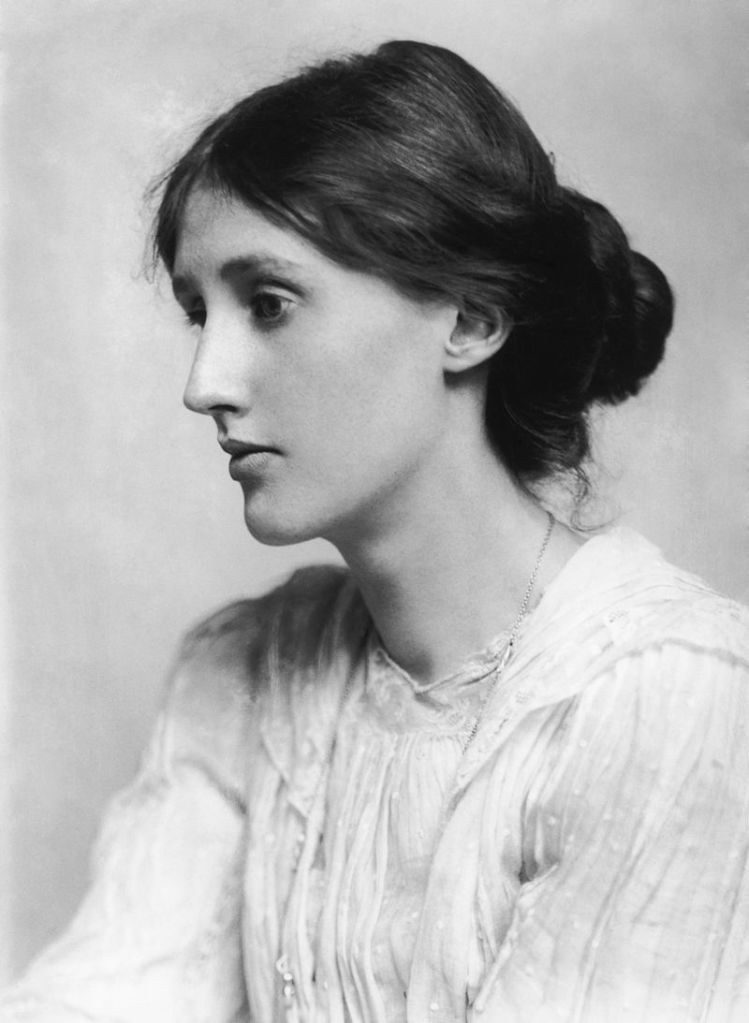
I feel I should give some account of all five women, but it would take too much space, and Wade has written about them so well that I shall leave you to find out more by reading her book. However, I must say a quick word about Virgnia Woolf as it’s from her writing that the book gets its name. “I like this London life in early summer – the street sauntering & square haunting,” she reveals in her diary in 1925. Years later, when she and husband Leonard moved from Tavistock Square to Mecklenburgh Square -on the eve of the Second World War – the allure of London was beginning to pall, and she was unhappy for much of her time there. She and Leonard were at their country home in Sussex when the square was bombed in 1940, and their house, along with many others, damaged beyond repair.
I loved this book. I’m only sorry it wasn’t available when my younger daughter was living in London, and I spent hours wandering around Bloomsbury, with its gardens and squares, on my way to the Persephone Bookshop. I must have unknowingly passed Mecklenburgh Square – or even wandered into it – without realising its history. But better perhaps, to visualise it as it was In 1917, when TS Eliot visited Hilda Doolittle (his colleague on the Egoist magazine). “London is an amazing place,” he wrote to his mother. “One is constantly discovering new quarters; this woman lives in a most beautiful dilapidated old square, which I had never heard of before; a square in the middle of town, near King’s Cross station, but with spacious old gardens about it.”
NB: If anyone wants to know more about Mecklenburgh Square, there is a fascinating website at
http://mecklenburghsquaregarden.org.uk/. It focuses on the garden which is private, but opens to the public once a year during Heritage Weekend. The site focuses on the garden, but also has a lot of information about the square’s history and the well known people who lived there during the 18thC and 19thC, as well as various campaigning organisations which were based there, including The People’s Suffrage League, and The Women’s Trade Union League.


 The Book Trunk
Leave a reply to chrisharding53 Cancel reply